Baseline PID Controller Design
R2026bA PID controller (proportional-integral-derivative controller) is a widely used linear feedback control strategy that applies a correction based on proportional, integral, and derivative terms.
Proportional (P) — Reduces error between reference and measurement.
Integral (I) — Reacts to the accumulation of past errors and eliminates the steady-state error.
Derivative (D) — Predicts future error based on the rate of change and improves stability and responsiveness.
Offline PID controller design usually provides a baseline controller for nominal plant obtained at a specific operating condition. It serves as a starting point before applying advanced tuning or compensation techniques for complex scenarios. The following image shows a typical workflow for designing a nominal PID controller.
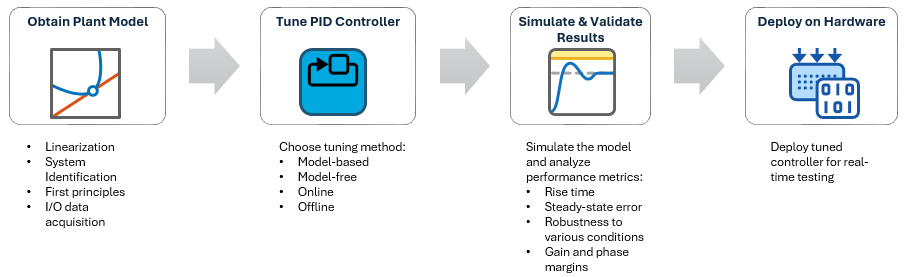
Control System Toolbox™ and Simulink® Control Design™ software provide many ways of designing PID controllers, including model-based and model-free methods, online and offline tuning techniques.
| Tool | Type | When To Use | Examples |
|---|---|---|---|
pidtune or PID Tuner app | Model-based offline tuning | Design controller gains for SISO models based on target phase margin and design focus such as disturbance rejection or reference tracking | |
systune or Control System Tuner app | Model-based multi-loop multi-objective tuning | Design controller gains that satisfy multiple time and frequency design requirements | |
| Control System Designer app | Model-based offline tuning | Interactively tune PID gains to balance performance and robustness or tune controllers using classical PID tuning formulas. | |
| Optimization-based tuning with Simulink Design Optimization™ software. | Model-free, offline tuning | Retune initial PID design based on performance requirements. |
|
Additionally, Simulink Control Design software provides advanced techniques for autotuning PID controllers such as Closed-Loop PID Autotuner and Virtual Reference Feedback Tuning.

