armcov
R2026bAutoregressive all-pole model parameters — modified covariance method
Description
Examples
Use a vector of polynomial coefficients to generate an AR(4) process by filtering 1024 samples of white noise. Use the modified covariance method to estimate the coefficients.
A = [1 -2.7607 3.8106 -2.6535 0.9238];

y = filter(1,A,0.2*randn(1024,1));

arcoeffs = armcov(y,4)
arcoeffs = 1×5

    1.0000   -2.7741    3.8404   -2.6841    0.9360
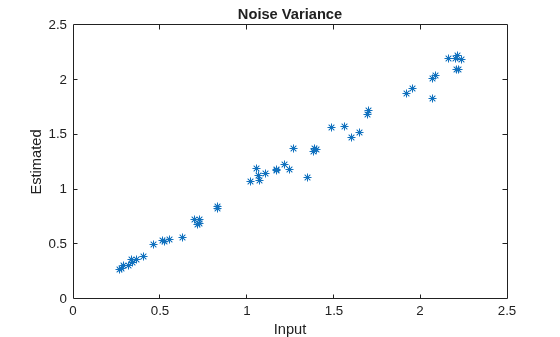
Generate 50 realizations of the process, changing each time the variance of the input noise. Compare the modified-covariance-estimated variances to the actual values.
nrealiz = 50;

noisestdz = rand(1,nrealiz) + 0.5;

randnoise = randn(1024,nrealiz);
noisevar = zeros(1,nrealiz);

for k = 1:nrealiz
    y = filter(1,A,noisestdz(k) * randnoise(:,k));
    [arcoeffs,noisevar(k)] = armcov(y,4);
end

plot(noisestdz.^2,noisevar,"*")
title("Noise Variance")
xlabel("Input")
ylabel("Estimated")
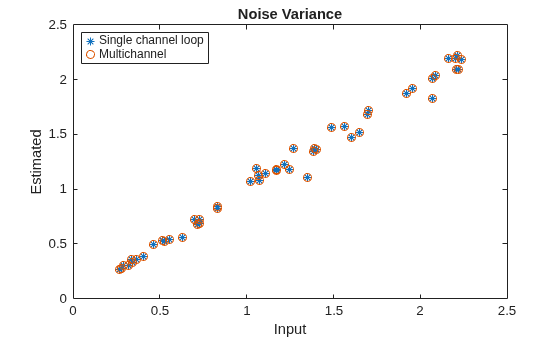
Repeat the procedure using the function's multichannel syntax.
Y = filter(1,A,noisestdz.*randnoise);

[coeffs,variances] = armcov(Y,4);

hold on
plot(noisestdz.^2,variances,"o")
hold off
legend("Single channel loop","Multichannel",Location="best")