2상 유체
R2026b2상 유체 네트워크는 블록 또는 네트워크의 내부와 외부 프로세스로 인해 단일 유체 상 변화가 일어날 수 있습니다.
도메인 라이브러리에 특정 컴포넌트가 아직 없는 경우 Simscape™ 언어를 사용하여 직접 만들 수 있습니다. 자세한 내용은 Creating Custom Components 항목을 참조하십시오.
카테고리
관련 정보
추천 예제
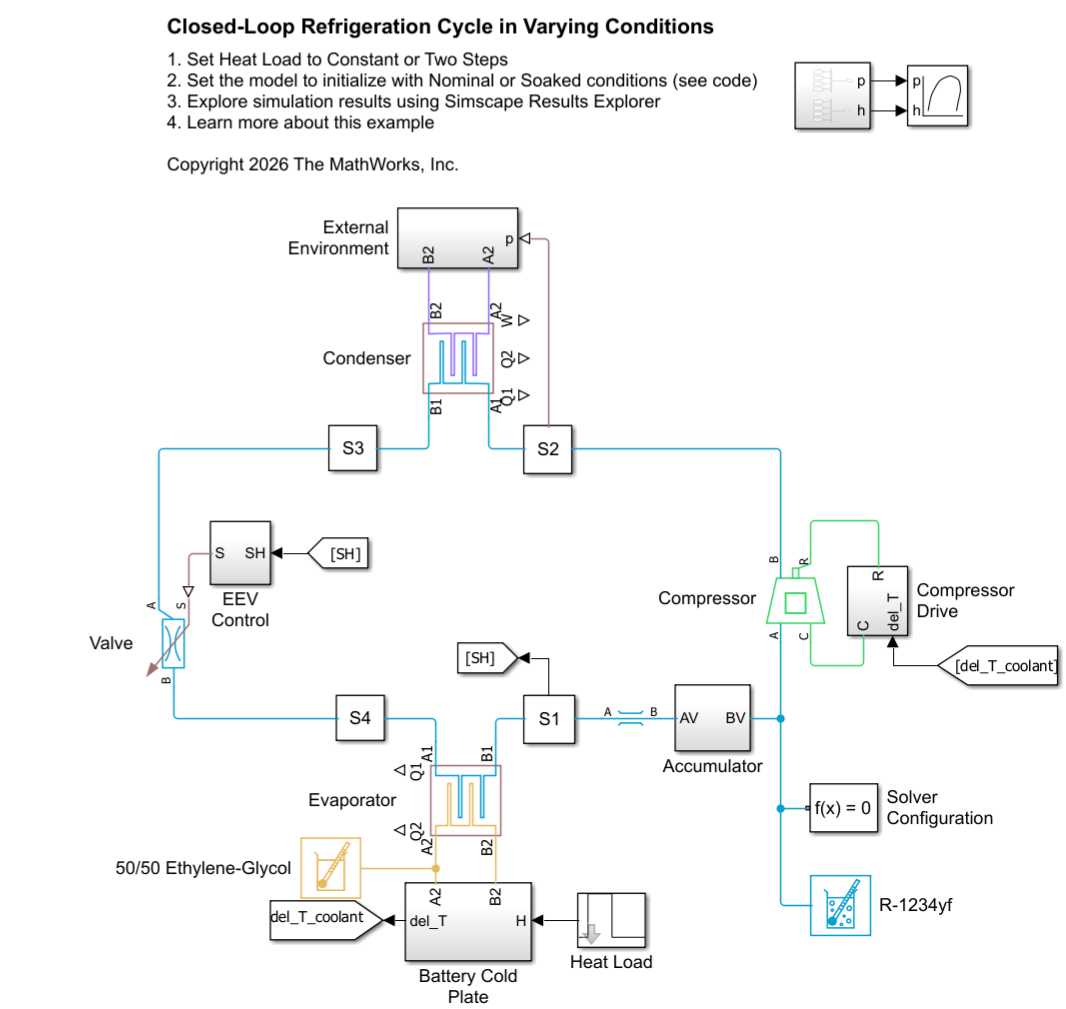
Troubleshoot a Refrigeration Cycle
Demonstrates potential modeling errors in a closed-loop two-phase refrigeration system and shows how to diagnose and fix them. The example covers each error by injecting a mistake, observing the symptoms, identifying the root cause, and applying the fix.
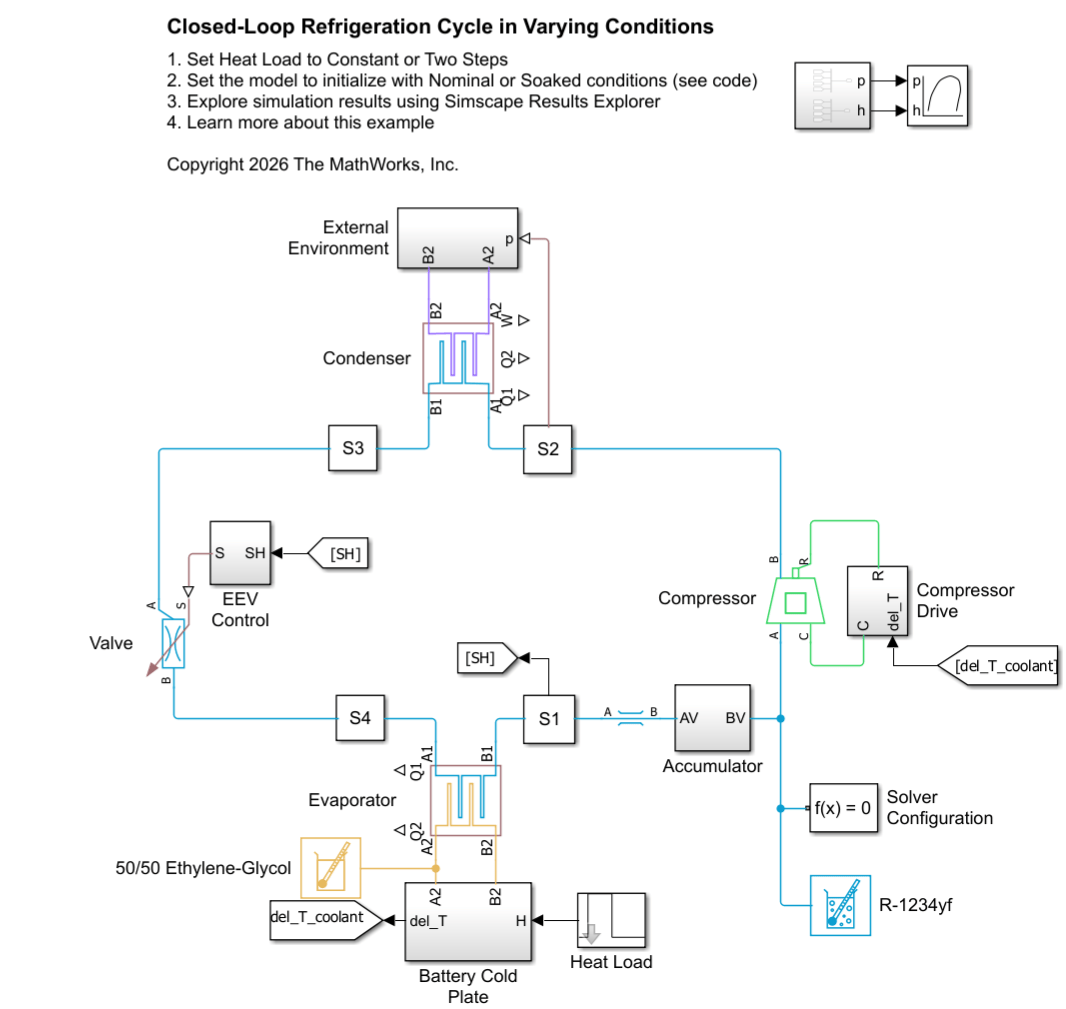
Model a Refrigeration Cycle with Varying Conditions
Extends the Model a Refrigeration Cycle workflow. That workflow develops a refrigeration system that initializes and operates at a nominal operating state. In that example, you choose pressure and enthalpy operating points and load and environment conditions, build open-loop test harnesses, and then close the refrigeration loop.
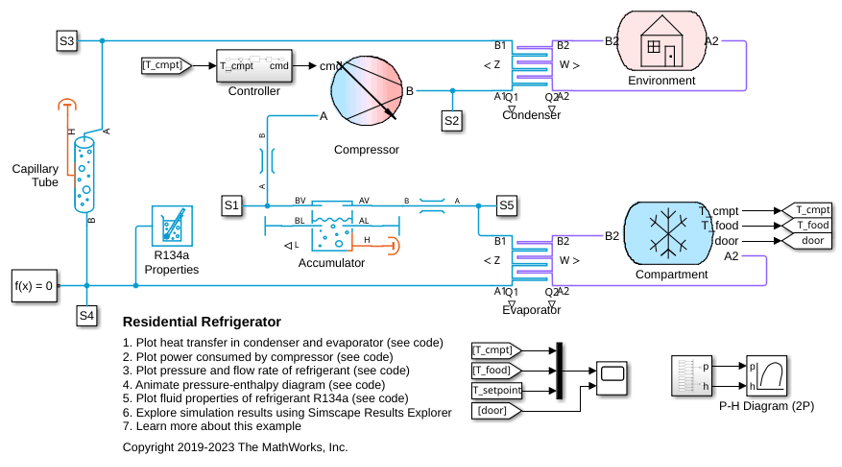
Residential Refrigerator
Models a basic refrigeration system that transfers heat between the refrigerant two-phase fluid and the environment moist air mixture. The compressor drives the R134a refrigerant through a condenser, a capillary tube, and an evaporator. An accumulator ensures that only vapor returns to the compressor.
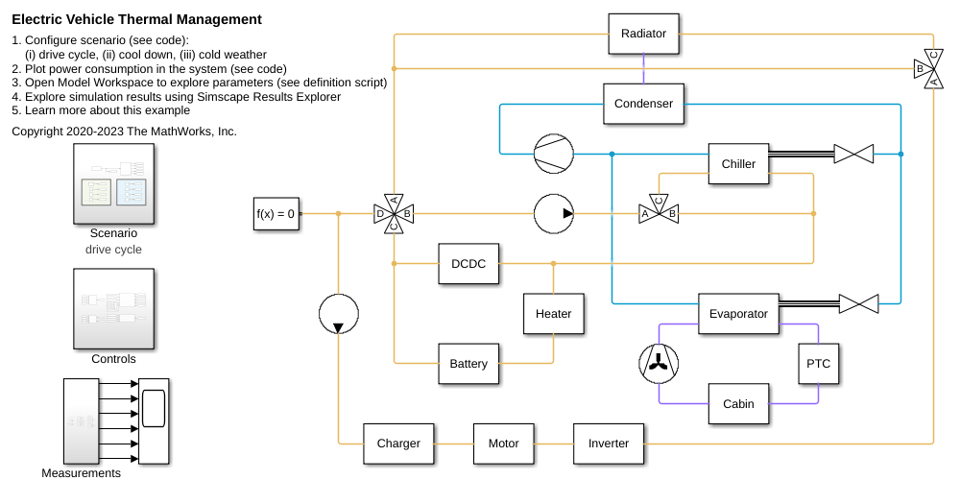
전기차 열 관리
배터리 전기차의 열 관리 시스템을 모델링합니다.
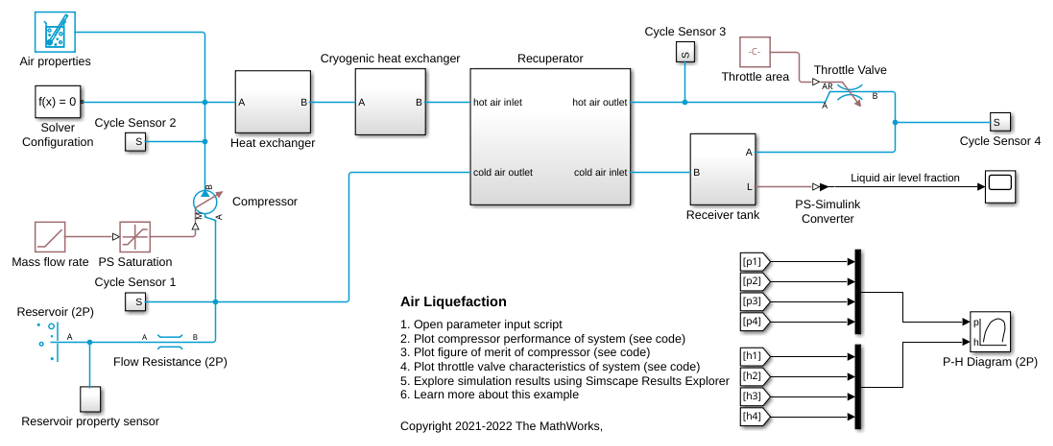
Air Liquefaction
Models a Linde-Hampson air liquefaction cycle using the two-phase fluid components. The compressor drives the vapor air through two heat exchangers, recuperator, expansion valve, and storage tank. The first heat exchanger contains water at atmospheric temperature, while the second heat exchanger contains refrigerant. The pressure drops as the cooled air passes through the expansion valve which results in condensation. The air and entrained condensation then pass through a receiver tank where the condensation separates from the air. The liquid air is stored in a receiver tank while the vapor air is circulated back to the compressor.
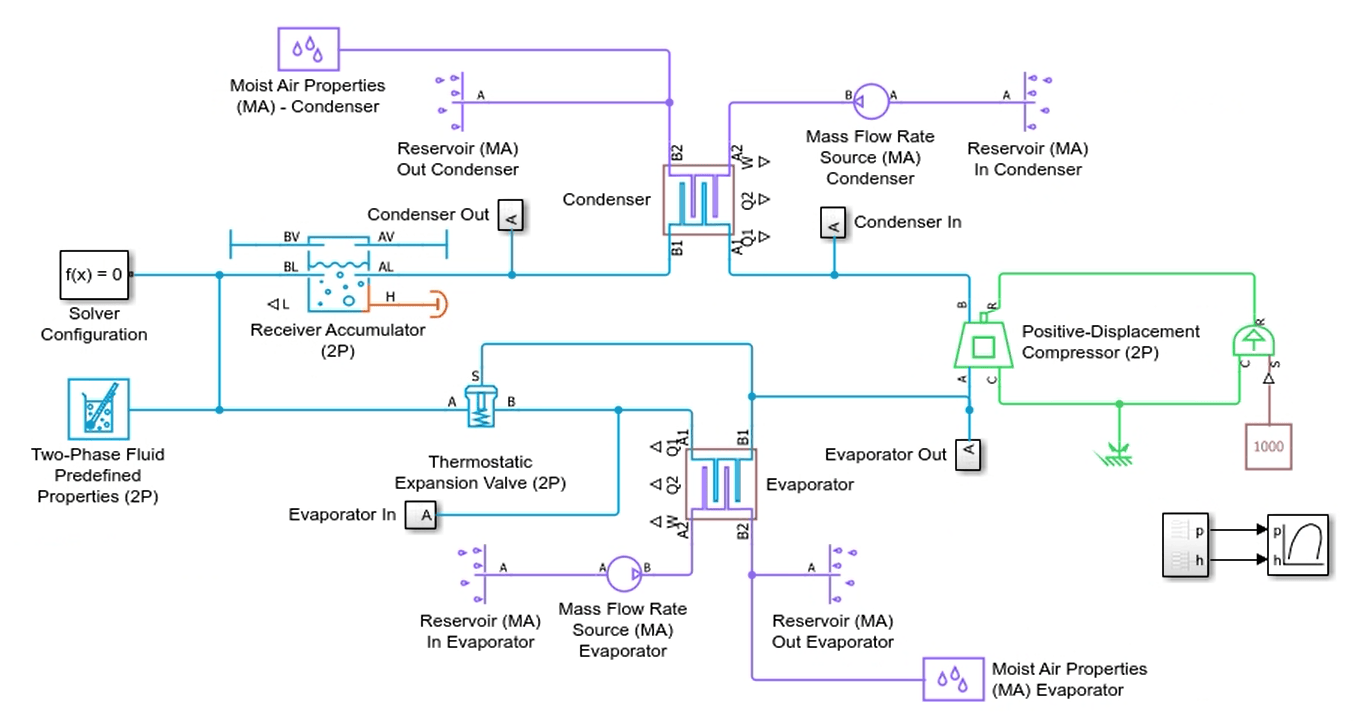
Model a Refrigeration Cycle
Explains how to model a closed-loop refrigeration cycle. Simulating a refrigeration cycle requires you to properly tune the component parameters. Imbalances in the net energy transfer can cause runaway system pressure and temperature. Because the refrigerant undergoes energy transfer that causes substantial and rapid density changes, you start by modeling and verifying the response of the individual components. You integrate the components into an open-loop system, and then close the loop.
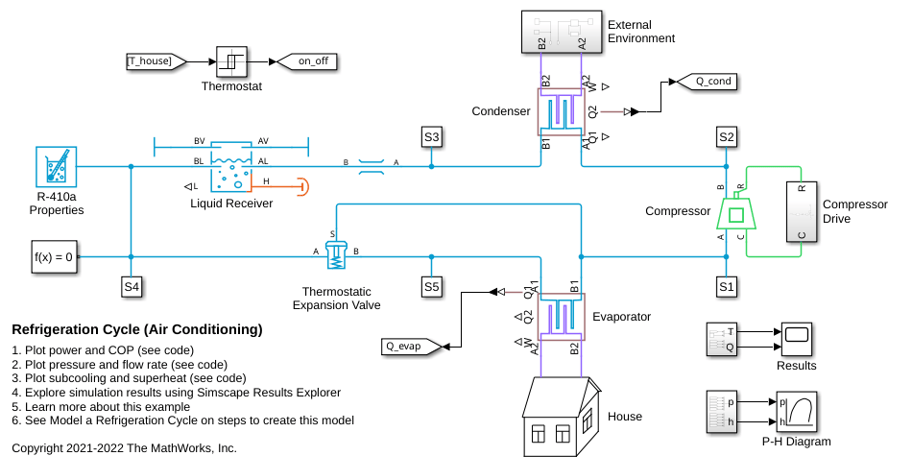
Refrigeration Cycle (Air Conditioning)
A refrigeration cycle for a home air conditioning system. See Model a Refrigeration Cycle for the recommended steps to build this model in the two-phase fluid domain.
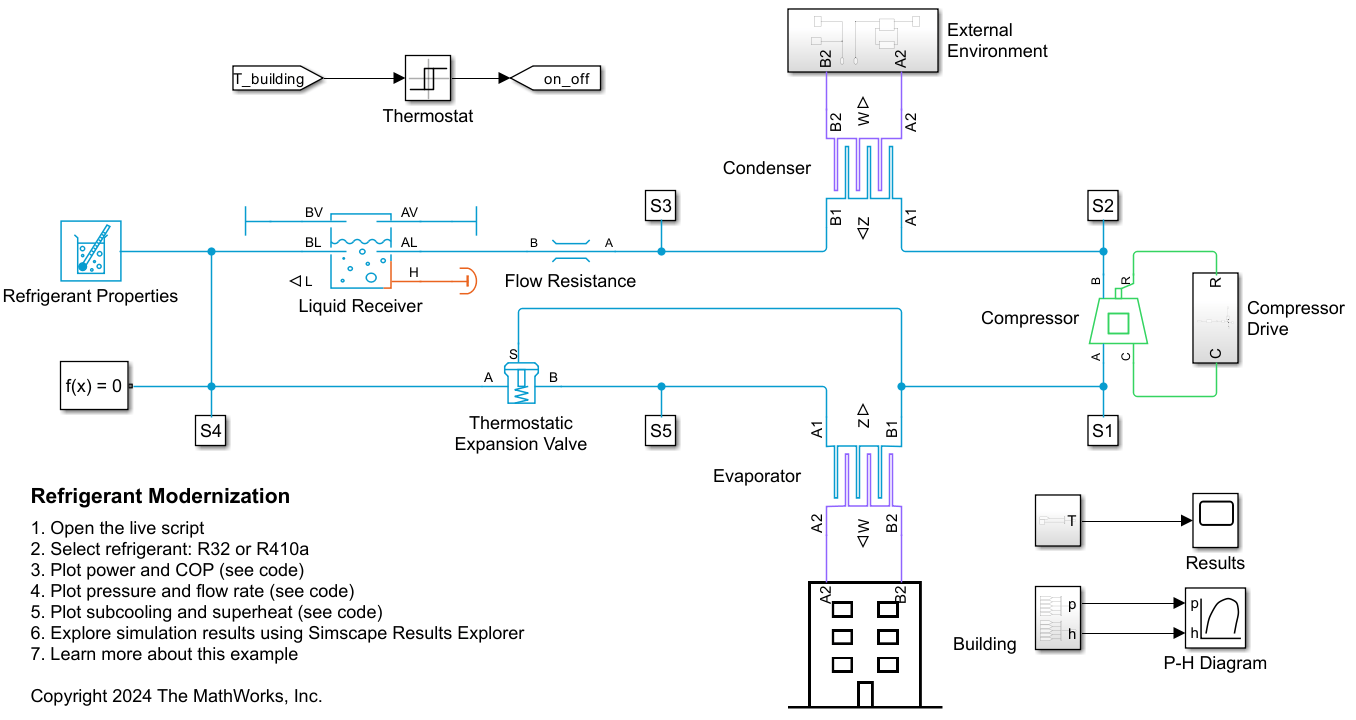
Refrigerant Modernization
Retrofit a Simscape™ cooling cycle that uses R410a to utilize R32, which is a refrigerant with a lower Global Warming Potential (GWP). The process involves modifying the nominal mass flow rate and refrigerant charge, while retaining the original evaporator and condenser specifications. For more information on designing a cooling cycle, see Model a Refrigeration Cycle and Refrigeration Cycle (Air Conditioning).
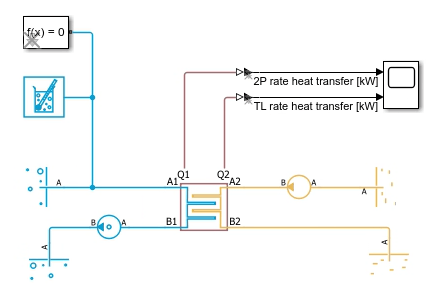
Initialize a System-Level Heat Exchanger
Specify the initial conditions for a system-level heat exchanger to prevent transient behavior at the start of the simulation. Properly specifying initial conditions can prevent unwanted behavior at the start of the simulation, such as spikes in values.
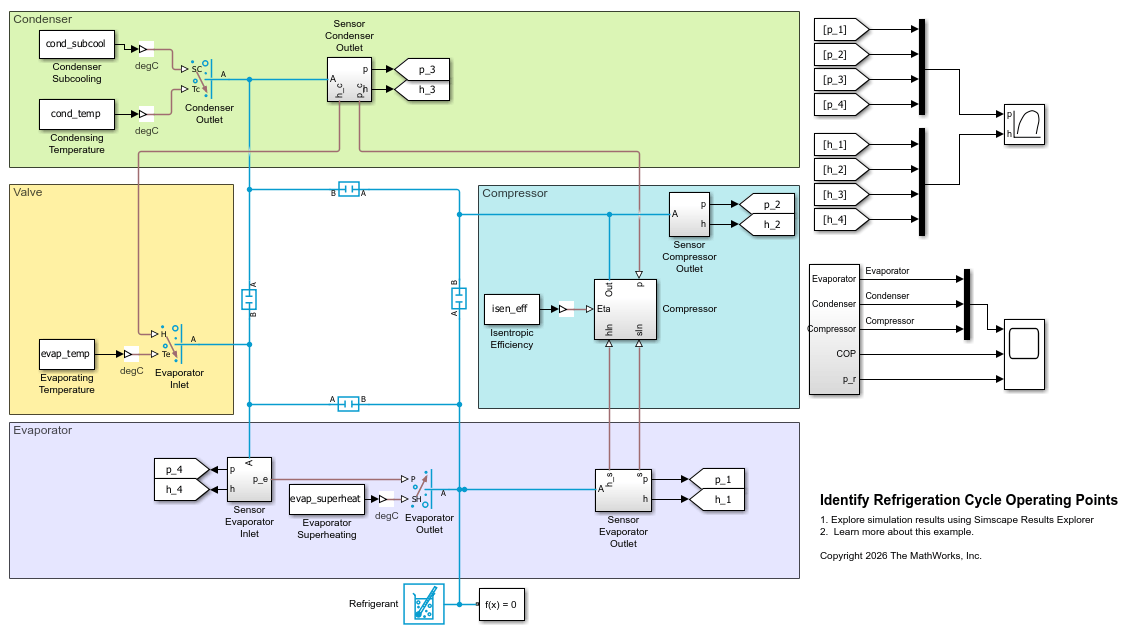
Identify Refrigeration Cycle Operating Points
Define and plot the four operating points of a vapor-compression refrigeration cycle on a P-h diagram. The model calculates the thermodynamic state at each operating point for the specified cycle conditions and computes the cycle performance metrics, including the coefficient of performance (COP) and pressure ratio. To understand the operating points of your own refrigeration system, replace the values in this model with the conditions for your system.
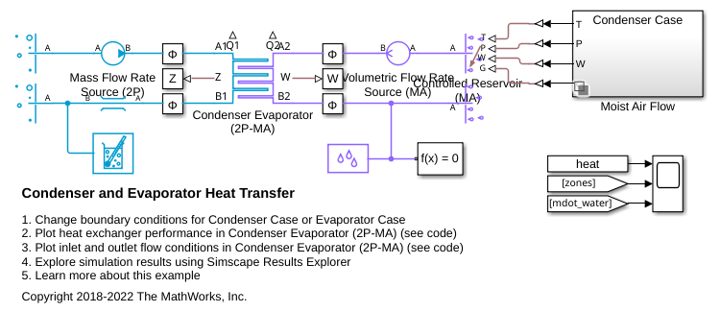
응축기 및 증발기 열 전달
이 예제에서는 왼쪽에 R134a 냉매가 있고 오른쪽에 습윤 공기가 있는 간단한 테스트 설정의 응축기 또는 증발기를 모델링합니다. 이 모델은 냉매로 채워진 튜브 뱅크 사이를 가로질러 습윤 공기가 흐르는 교차 유동 구조를 가집니다.
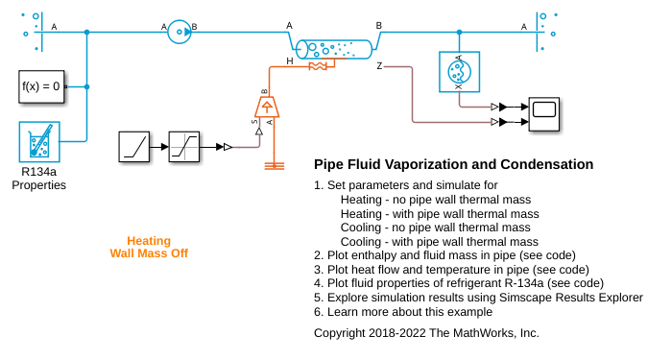
Pipe Fluid Vaporization and Condensation
The 3-Zone Pipe (2P) block used to model vaporization or condensation of fluid flow in a pipe. The block divides the internal fluid volume into up to three zones: liquid zone, mixture zone, and vapor zone, depending on the state of the fluid along the pipe. As fluid flows through the pipe, heat is transferred between the environment external to the pipe and the fluid inside the pipe, causing it to change from liquid to mixture to vapor for the heating case or from vapor to mixture to liquid for the cooling case. The effect of thermal storage in the pipe wall can be optionally turned on by specifying a nonzero pipe wall thickness.
Residential Air Source Heat Pump
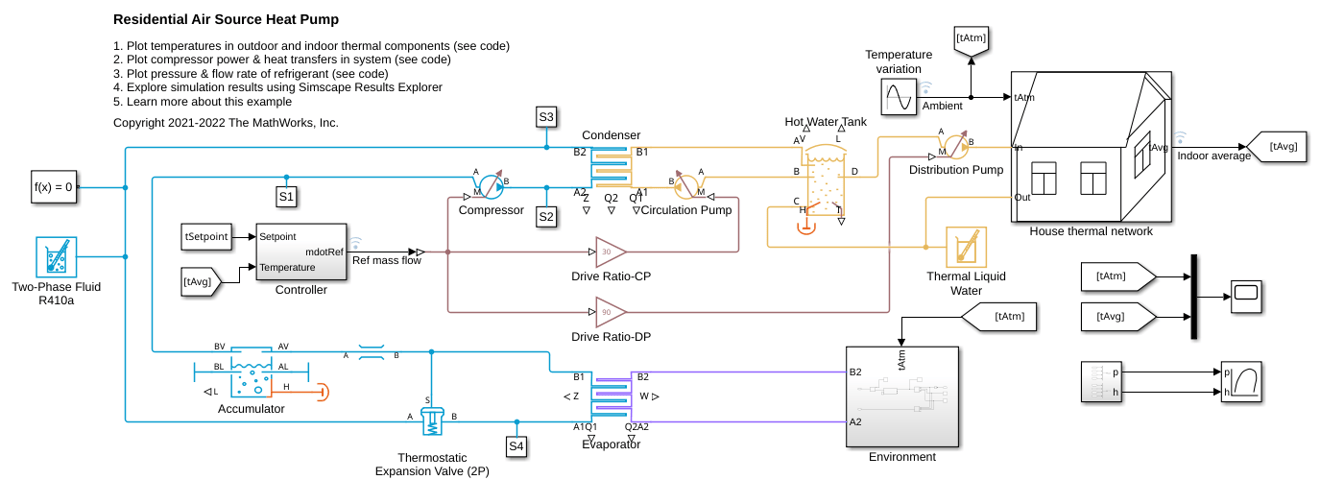
Models an air source heat pump system that is used to heat a residential building having hot-water radiators for heat distribution. The two-phase fluid refrigerant takes up heat from the environment moist air mixture and transfers heat to water. The compressor drives the R410a refrigerant through a condenser, a thermostatic expansion valve, and an evaporator. An accumulator ensures that only vapor returns to the compressor.
Residential Ground Source Heat Pump
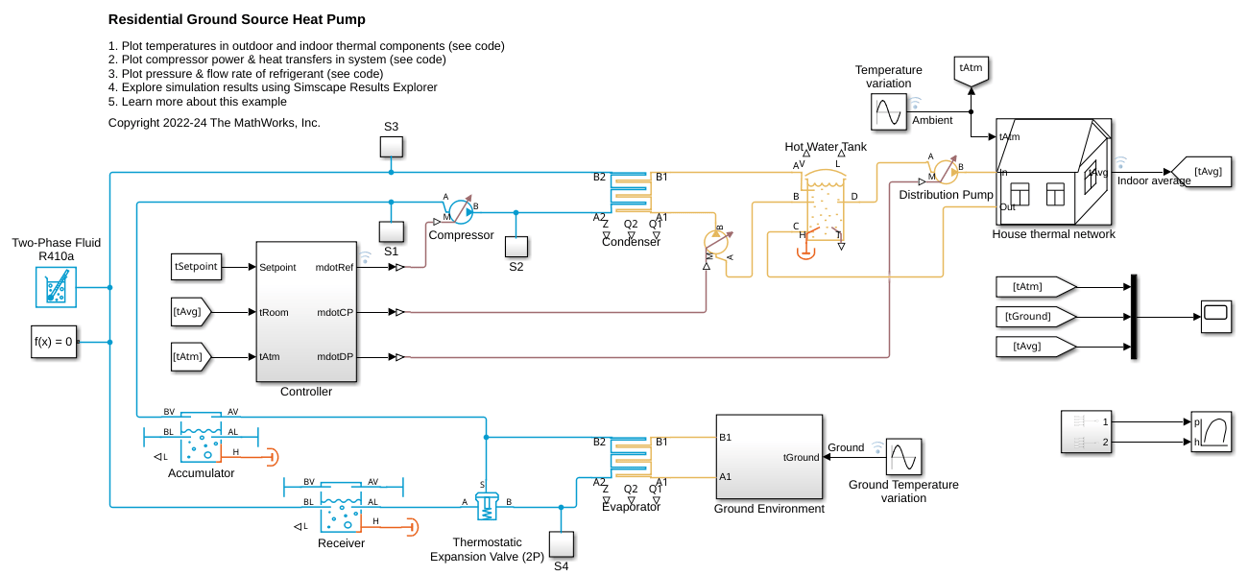
Models a ground source heat pump system that is used to heat a residential building having hot-water radiators for heat distribution. The ground source heat pump uses R410a, a two-phase fluid refrigerant, as the working fluid. The heat pump takes up the naturally existing heat stored in the ground and transfers the heat to the hot-water radiators. The compressor drives the refrigerant through a condenser, a thermostatic expansion valve, and an evaporator. An accumulator ensures that only vapor returns to the compressor. A receiver ensures that only liquid returns to the thermostatic expansion valve.

