Hypergeometric Distribution
R2026bDefinition
The hypergeometric pdf is
Background
The hypergeometric distribution models the total number of successes in a fixed-size sample drawn without replacement from a finite population.
The distribution is discrete, existing only for nonnegative integers less than the number of samples or the number of possible successes, whichever is greater. The hypergeometric distribution differs from the binomial only in that the population is finite and the sampling from the population is without replacement.
Sampling “without replacement” means that once a particular sample is chosen, it is removed from the relevant population for all subsequent selections.
Parameters
The hypergeometric distribution uses the following parameters.
| Parameter | Description | Support |
|---|---|---|
| M | Size of the population | M = 1, 2, 3,... |
| K | Number of items with the desired characteristic in the population | K = 1, 2, 3,... |
| n | Number of samples drawn | n = 1, 2, 3,... |
Examples
Compute and Plot Hypergeometric Distribution CDF
This example shows how to compute and plot the cdf of a hypergeometric distribution.
Compute the cdf of a hypergeometric distribution that draws 20 samples from a group of 1000 items, when the group contains 50 items of the desired type.
x = 0:10;
y = hygecdf(x,1000,50,20);
Plot the cdf.
stairs(x,y)
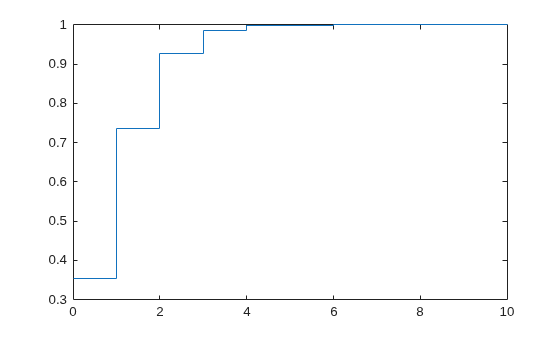
The x-axis of the plot shows the number of items drawn that are of the desired type. The y-axis shows the corresponding cdf values.
See Also
hygecdf | hygepdf | hygeinv | hygestat | hygernd | random

