열 교환기
R2026b서로 다른 도메인 간의 열 교환 또는 토폴로지가 서로 다른 네트워크 간의 열 교환을 모델링하려면 다음 블록을 사용하십시오.
도메인 라이브러리에 특정 컴포넌트가 아직 없는 경우 Simscape™ 언어를 사용하여 직접 만들 수 있습니다. 자세한 내용은 Creating Custom Components 항목을 참조하십시오.
카테고리
- 기체
기체 열 교환기
- 습윤 공기
습윤 공기 열 교환기
- 열 유체
열 유체 열 교환기
- 열 유체 - 기체
열 유체와 기체 간 열 교환기
- 열 유체 - 습윤 공기
열 유체와 습윤 공기 간 열 교환기
- 2상 유체
2상 유체 열 교환기
- 2상 유체 - 기체
2상 유체와 기체 간 열 교환기
- 2상 유체 - 습윤 공기
2상 유체와 습윤 공기 간 열 교환기
- 2상 유체 - 열 유체
2상 유체와 열 유체 간 열 교환기
- 기본 컴포넌트
열 교환기 컴포넌트
관련 정보
추천 예제
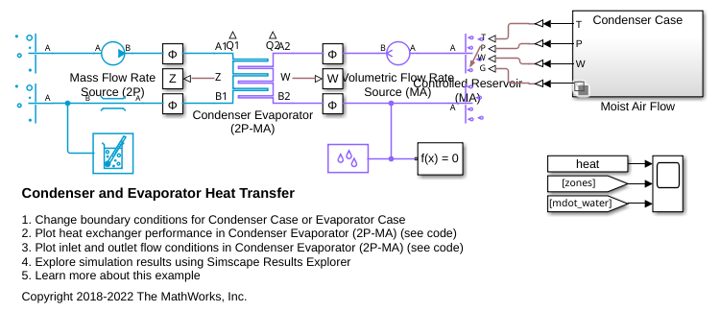
Condenser and Evaporator Heat Transfer
Models a condenser or an evaporator in simple test setup with R134a refrigerant on the left side and moist air on the right side. It has a cross flow arrangement with the moist air blowing across tube banks filled with the refrigerant.
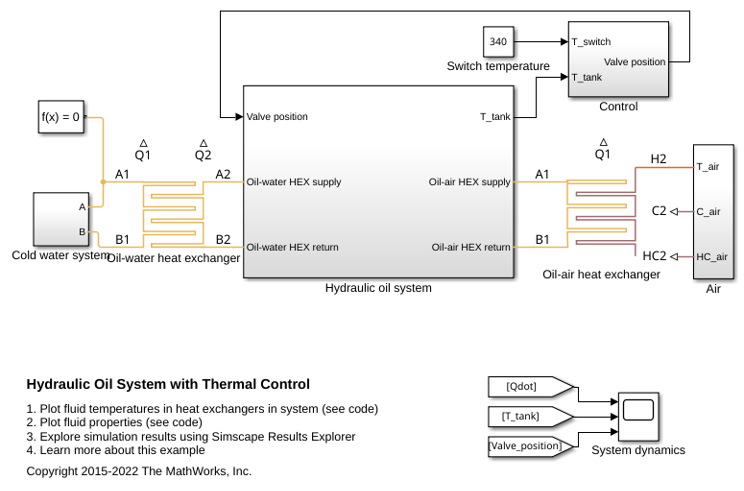
Hydraulic Oil System with Thermal Control
A hydraulic oil system with a thermal control using Simscape™ Fluids™ Thermal Liquid blocks. The hydraulic oil system consists of an oil storage tank represented by the Tank (TL) block with two inlets, a pump represented by a Mass Flow Rate Source (TL) block, and pipelines represented by Pipe (TL) block.

전기차 열 관리
배터리 전기차의 열 관리 시스템을 모델링합니다.
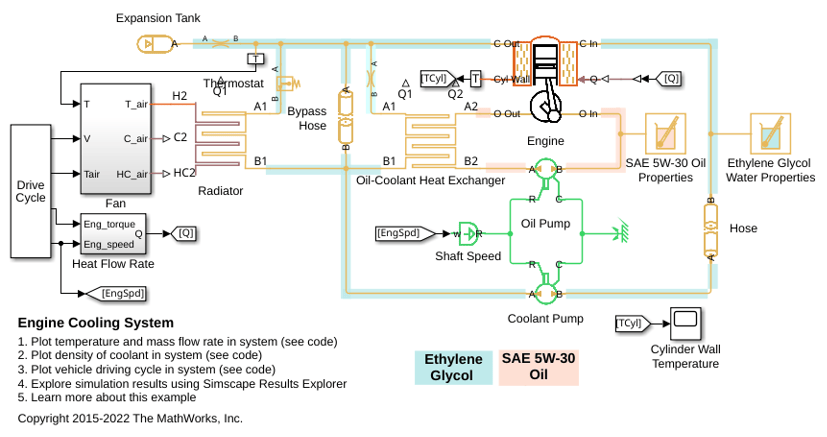
Engine Cooling System
Model an engine cooling system with an oil cooling circuit.
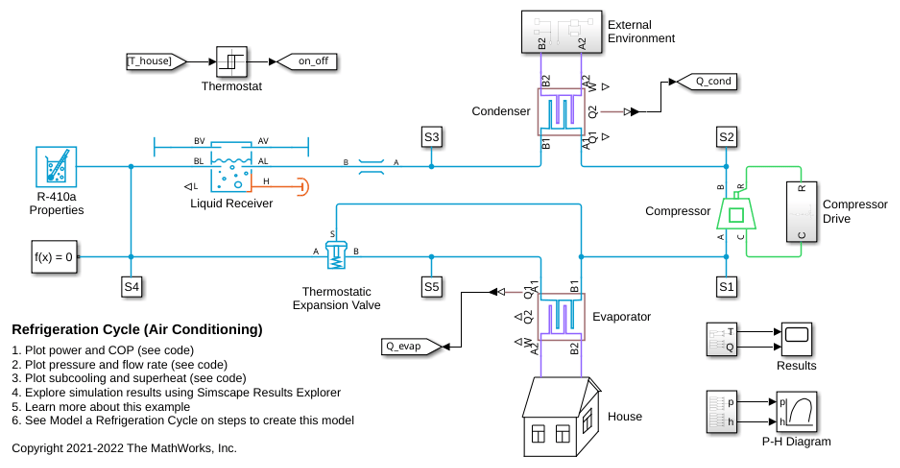
Refrigeration Cycle (Air Conditioning)
A refrigeration cycle for a home air conditioning system. See Model a Refrigeration Cycle for the recommended steps to build this model in the two-phase fluid domain.
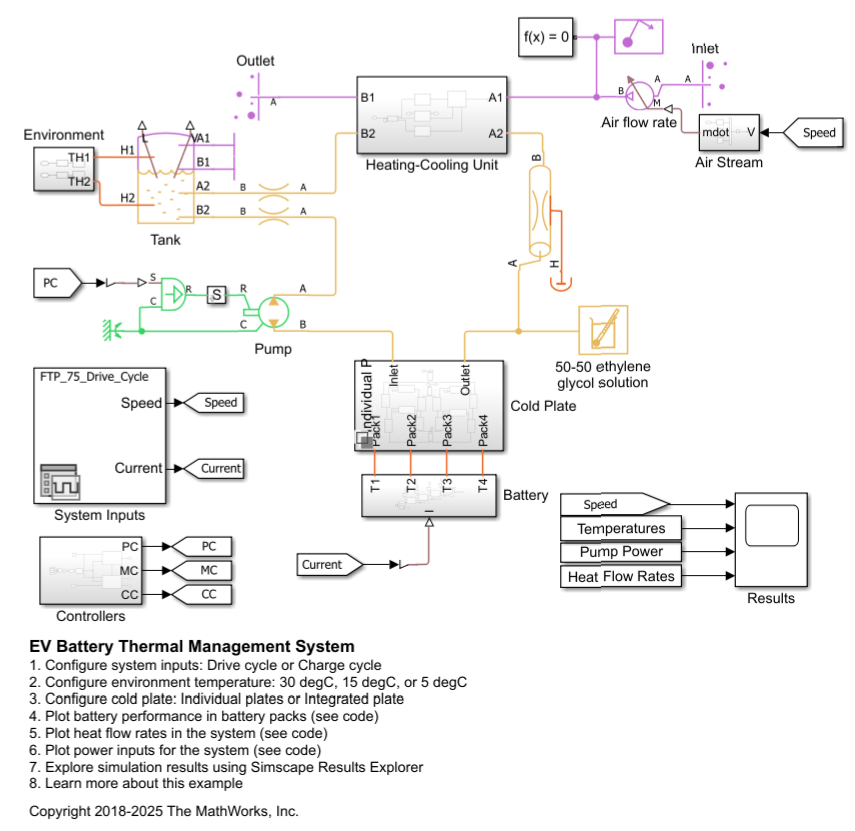
EV Battery Thermal Management System
An Electric Vehicle (EV) battery heating-cooling system. Maintaining the battery temperature within an optimal range is important for efficient charging and discharging. The model simulates either the FTP-75 drive cycle or a fast charge cycle at different environment temperatures. A thermal liquid coolant circuit conveys heat between the battery and the heating-cooling unit. For more information on designing EV battery cooling systems, see EV Battery Cooling System Design.
Engine Cooling System
Model an engine cooling system with an oil cooling circuit.
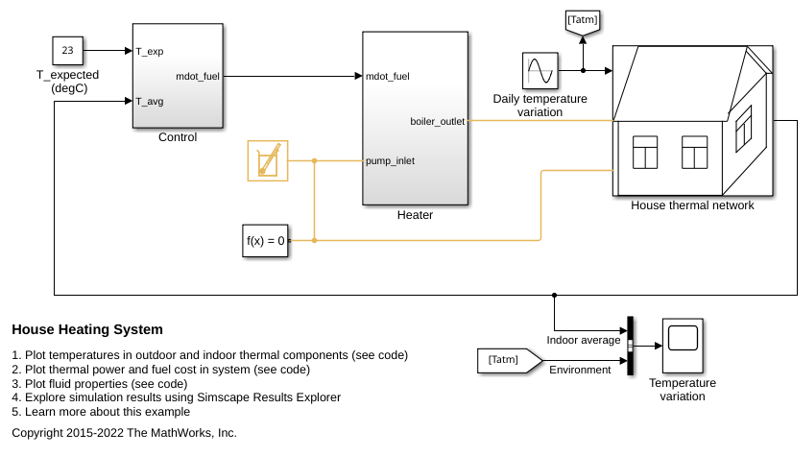
House Heating System
Model a simple house heating system. The model contains a heater, a controller, and a house structure with four radiators and four rooms. Each room exchanges heat with the environment through its exterior walls, roof, and windows. Each path is simulated as a combination of a thermal convection, thermal conduction, and the thermal mass. It is assumed that heat is not transferred internally between rooms. The heater consists of a furnace, a boiler, an accumulator, and a pump to circulate hot water in the system. The controller starts admitting fuel into the furnace if the overall average temperature of rooms falls below 21 degree C and it stops if the temperature exceeds 25 degree C. The simulation calculates the heating cost and indoor temperatures.
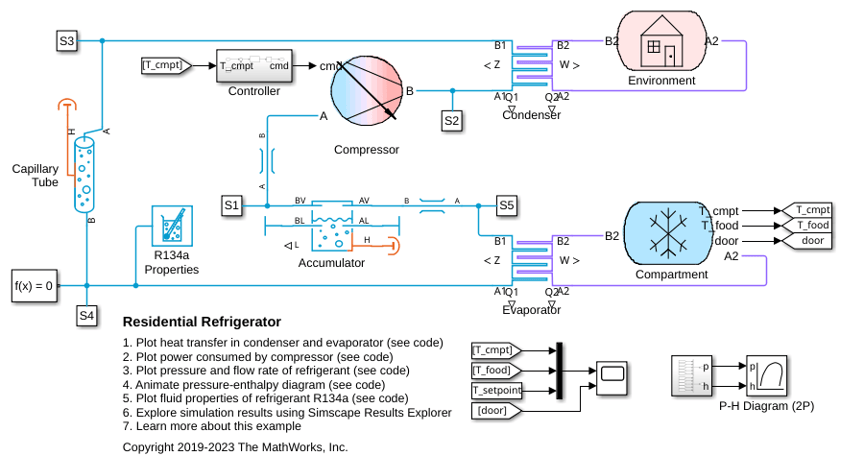
Residential Refrigerator
Models a basic refrigeration system that transfers heat between the refrigerant two-phase fluid and the environment moist air mixture. The compressor drives the R134a refrigerant through a condenser, a capillary tube, and an evaporator. An accumulator ensures that only vapor returns to the compressor.
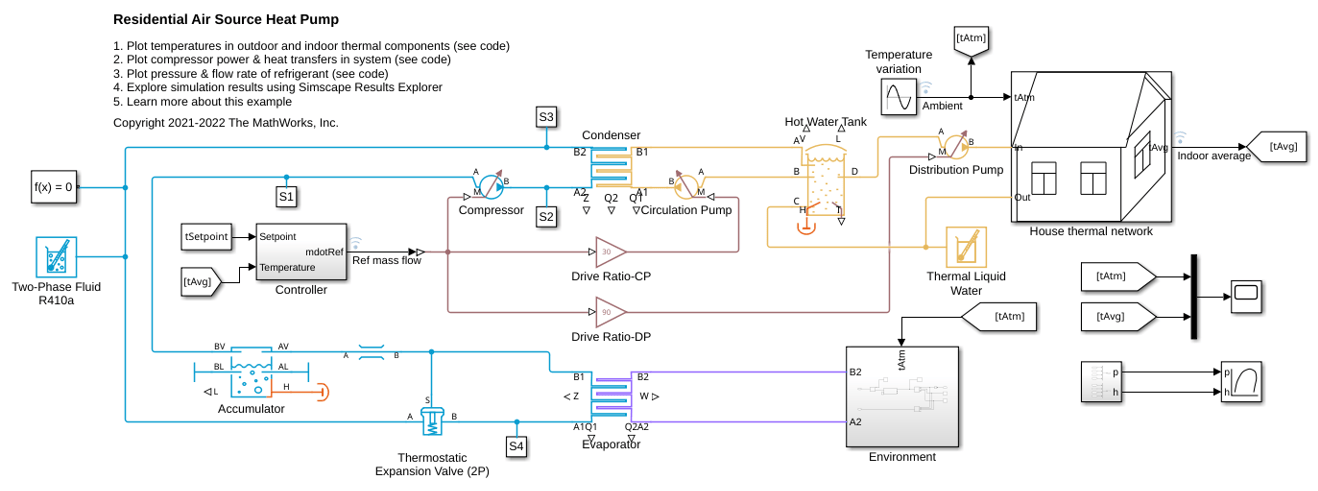
Residential Air Source Heat Pump
Models an air source heat pump system that is used to heat a residential building having hot-water radiators for heat distribution. The two-phase fluid refrigerant takes up heat from the environment moist air mixture and transfers heat to water. The compressor drives the R410a refrigerant through a condenser, a thermostatic expansion valve, and an evaporator. An accumulator ensures that only vapor returns to the compressor.
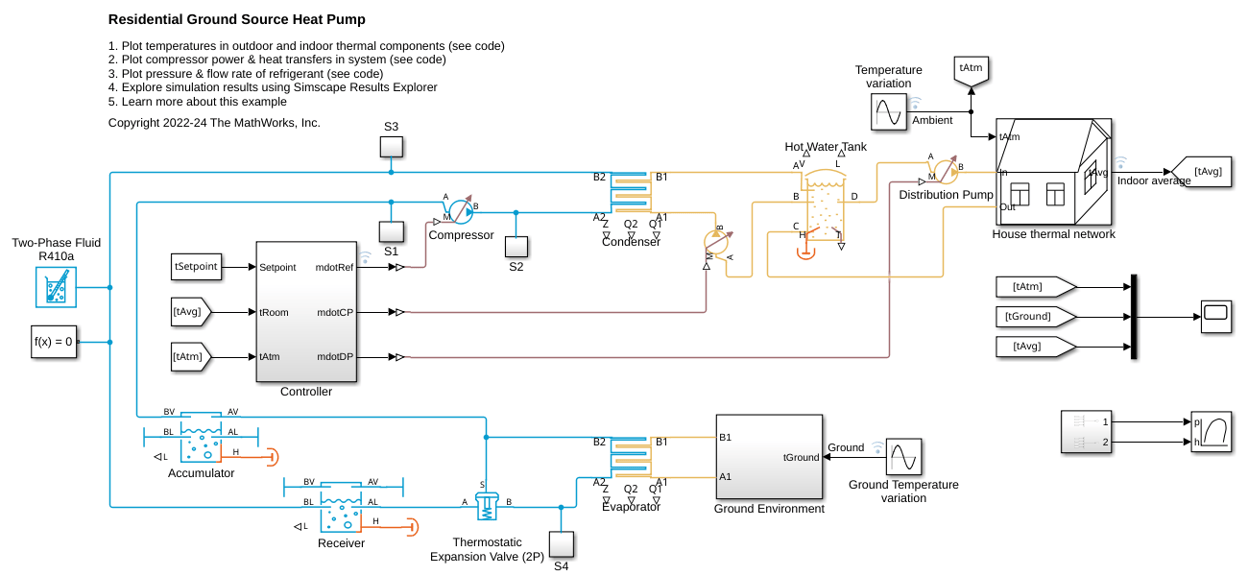
Residential Ground Source Heat Pump
Models a ground source heat pump system that is used to heat a residential building having hot-water radiators for heat distribution. The ground source heat pump uses R410a, a two-phase fluid refrigerant, as the working fluid. The heat pump takes up the naturally existing heat stored in the ground and transfers the heat to the hot-water radiators. The compressor drives the refrigerant through a condenser, a thermostatic expansion valve, and an evaporator. An accumulator ensures that only vapor returns to the compressor. A receiver ensures that only liquid returns to the thermostatic expansion valve.
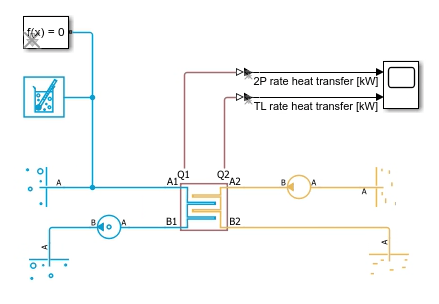
Initialize a System-Level Heat Exchanger
Specify the initial conditions for a system-level heat exchanger to prevent transient behavior at the start of the simulation. Properly specifying initial conditions can prevent unwanted behavior at the start of the simulation, such as spikes in values.
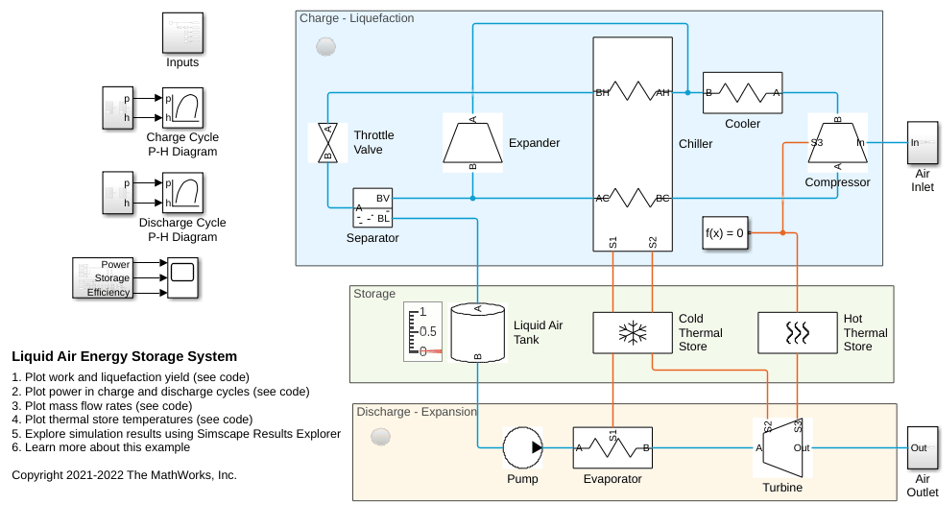
Liquid Air Energy Storage System
Models a grid-scale energy storage system based on cryogenic liquid air. When there is excess power, the system liquefies ambient air based on a variation of the Claude cycle. The cold liquid air is stored in a low-pressure insulated tank until needed. When there is high power demand, the system expands the stored liquid air to produce power based on the Rankine cycle.
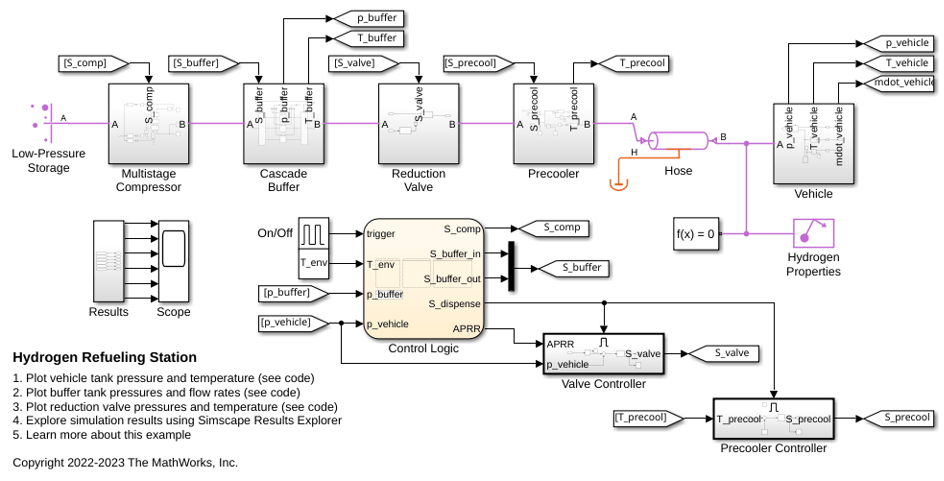
Hydrogen Refueling Station
Models a hydrogen refueling station. Hydrogen is stored in low-pressure storage tanks at 200 bar at the station. A 3-stage intercooled compressor maintains the necessary pressure in a cascade buffer storage system so that the station is ready to dispatch hydrogen to any connected vehicles. The buffer is divided into high-pressure tanks at 950 bar, medium-pressure tanks at 650 bar, and low-pressure tanks at 450 bar. To avoid wasting compression energy, the lowest pressure buffer that is greater than the vehicle tank pressure is used to dispatch hydrogen. Priority valves switches between the different buffer tanks to control which buffer tanks to fill and discharge from.
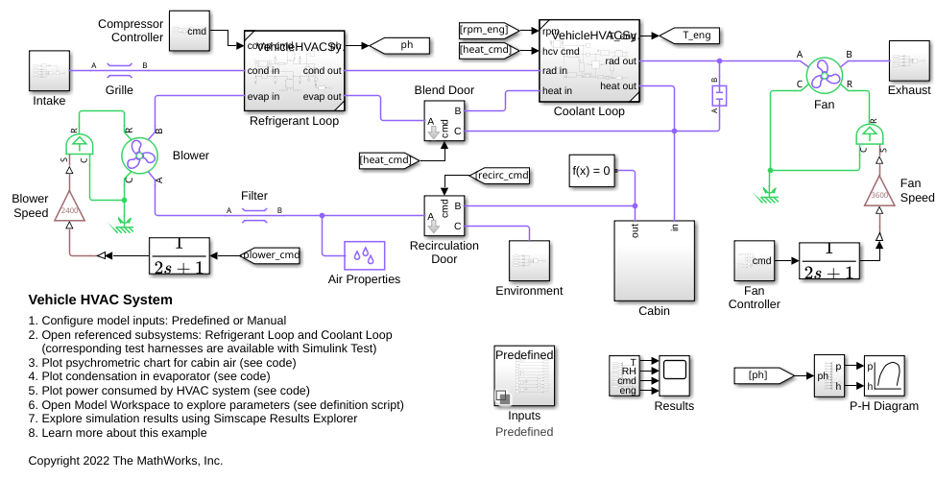
Vehicle HVAC System
Models the heating and cooling system of a passenger car. The cabin is represented as a volume of moist air exchanging heat with the external environment. The blower drives moist air through the evaporator, blend door, and heater core before returning to the cabin. The blend door controls the amount of air flow through the heater core. The recirculation door controls whether air is brought in from the external environment or from within the cabin.

