augdelay
R2026bSyntax
Description
Examples
This example shows how to obtain a state-space model with internal delay signals appended as model outputs using the augdelay function. This is useful when you want to map the contribution of the internal delays to extra output channels and monitor their contributions.
Construct a random state-space model with internal delays.
rng(0)
H = rss(2,4,3);  tau = [0.7 1.5];
S = struct('dx',[1;2],'x',[-1;1],'u',[0;1;2],'y',[-2;-1;.7;0]);
H.Offsets = S;
sys = setDelayModel(H,tau);
sys.OutputName = {'y1';'y2'}
sys =
  A =
            x1       x2
   x1   -0.363    0.136
   x2  -0.6539   -1.314

  B =
            u1
   x1     0.21
   x2  -0.1233

  C =
           x1      x2
   y1   1.409  0.7172
   y2  -1.872  0.3582

  D =
           u1
   y1       0
   y2  -2.115

  (values computed with all internal delays set to zero)

  Internal delays (seconds): 0.7  1.5

Continuous-time state-space model with offsets.
Model Properties
Here, sys is a one-input two-output model with offsets, and two internal delay channels.
Now, obtain the augmented model with internal delay signals appended as extra output channels.
asys = augdelay(sys)
asys =
  A =
            x1       x2
   x1   -0.363    0.136
   x2  -0.6539   -1.314

  B =
            u1
   x1     0.21
   x2  -0.1233

  C =
           x1      x2
   y1   1.409  0.7172
   y2  -1.872  0.3582
   z1  0.6715  0.4889
   z2  -1.751  0.6389

  D =
           u1
   y1       0
   y2  -2.115
   z1  0.2939
   z2  -1.025

  (values computed with all internal delays set to zero)

  Internal delays (seconds): 0.7  1.5

Output groups:
    Name    Channels
   delays     3,4
Continuous-time state-space model with offsets.
Model Properties
augdelay returns a state-space model with two extra outputs z1 and z2 corresponding to the contribution of each delay channel and adds an output group delays. Additionally, the function also augments the output offset with the z0 offset.
sys.Offsets.y
ans = 2×1

   -2.0000
   -3.1833
asys.Offsets.y
ans = 4×1

   -2.0000
   -3.1833
    0.7000
    0.2428
Using this new output group, you can monitor the contribution of these internal delay signals over time. For example, compute the step response of the delays output group.
stepplot(asys('delays',:))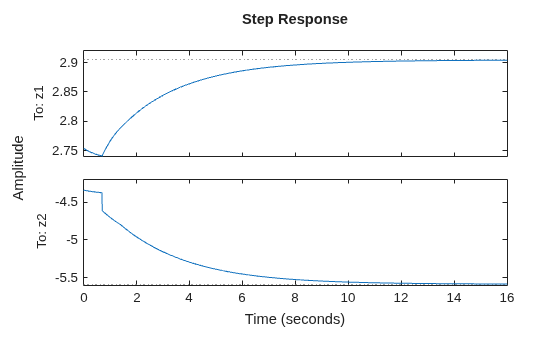
Input Arguments
Output Arguments
Version History
Introduced in R2026a

