Damping and frequency from simulation data
이전 댓글 표시
I have some simulation data, for example y in the attachment. I can manually calculate the damping and frequency with logarithmic decrement, but can I do this automated? I can't seem to figure out how.
And/or can I fit a nonlinear function through my datapoints? I tried polyfit but that doesn't work with time series.
댓글 수: 2

Ameer Hamza
2020년 4월 2일
How do you manually calculate the damping and frequency? Is there a mathematical formula? What type of nonlinear fit do you want to fit your data?

MM
2020년 4월 3일
I calculated it like they did here:
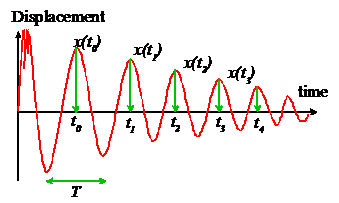

With damping: 
And frequency: 
What type of nonlinear fit? I don't know, any that will work. I was hoping a fit would maybe let me help to calculate the frequency and daming ratio
답변 (1개)
Ameer Hamza
2020년 4월 3일
The following code automatically estimate the parameters from the signal.
load('PositionY_example.mat');
[val, locs] = findpeaks(y.Data);
peak_times = y.Time(locs);
t0 = t(locs(1));
tn = t(locs(2:end));
omega = mean((1:numel(tn))'./(tn-t0));
xt0 = val(1);
xtn = val(2:end);
delta = mean(log(xtn./xt0)./(1:numel(xtn))');
zeta = delta/sqrt(4*pi^2+delta^2);
As you already know the value of ω, δ, and ζ of your signal, you can calculate the nonlinear fit for your data using this equation.

댓글 수: 2

Maitham Alabbad
2021년 12월 8일
What is variable t represent ?
t0 = t(locs(1));
tn = t(locs(2:end));

MD Riaz Pervez
2023년 4월 28일
t represent time. Here use t=Time therefore change that to make a single
카테고리
도움말 센터 및 File Exchange에서 Nonlinear Control에 대해 자세히 알아보기
2023년 4월 28일
Community Treasure Hunt
Find the treasures in MATLAB Central and discover how the community can help you!
Start Hunting!
Translated by 

