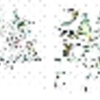
How to perform double integration of exp(-ax-by)*(x^m)*(y^n)/(cx+dy)where x & y lies between 0 and infinity, a,b,m,n,c,d are positive real numbers.
Thank you.

 채택된 답변

Mike Hosea
Mike Hosea 2012년 3월 20일

2 개 추천

If you have the 2012a release, just use INTEGRAL2:
>> a = 2; b = 3; m = 2; n = 3; c = 2; d = 3;
>> f = @(x,y)exp(-a*x-b*y).*(x.^m).*(y.^n)./(c*x+d*y)
f =
@(x,y)exp(-a*x-b*y).*(x.^m).*(y.^n)./(c*x+d*y)
>> integral2(f,0,inf,0,inf)
ans =
0.0030864
Be sure to use .*, .^, and ./ to do elementwise operations instead of matrix ops.
If you don't have 2012a yet, you can use the solution I presented here: http://www.mathworks.com/matlabcentral/answers/14514-double-integral-infinite-limits

댓글 수: 4

Kala
Kala 2012년 3월 27일
편집: Walter Roberson 2023년 6월 17일
Thank you Mr.Mike Hosea for your help. Now I'm facing one more problem. Here is my code...
for l = 0:k-1 %k value is given in the beginning
for m = 0:r %r value is also given in the beginning
A1 = (nchoosek(k-1,l)*nchoosek(r,m)*(-1)^(l+m));
f = @(x,y)exp(-a*x-b*y).*(x.^m).*(y.^n)./(c*x+d*y);
I = integral2(f,0,inf,0,inf);
A2 = A1 * I;
end
end
Is this possible ?? Can we call Integral function inside the loops ?? And a and b values are calculated previously in the same program and our integral has to use the same values of a and b. please help.
Mike Hosea
Mike Hosea 2012년 3월 27일
It should work.
Kala
Kala 2012년 3월 31일
편집: Walter Roberson 2023년 6월 17일
Yes sir.. It has worked. Thanks for your help. Now I have one more doubt.Here is my code..
part1=((xij)^(n1*k+alpha))*((yij)^(n2*r+beta))*k/(gamma(n2*r+beta)*gamma(n1*k+alpha));
I2=0;
for l=0:k-1
for m=0:r
part2=nchoosek(k-1,l)*nchoosek(r,m)*(-1)^(l+m);
I=mydblquad(@(v,u) fun2(v,u,xij, yij, n1, n2, k, r, alpha, beta,l,m),0,inf,0,inf);
I2=I2+part2*I;
end
end
Rpbcap=I2*part1;
%Baye's estimator for Series
part3=((xij)^(n1*k+alpha))*((yij)^(n2*r+beta))*r/(gamma(n2*r+beta)*gamma(n1*k+alpha));
I3=0;
for m=0:r-1
part4=nchoosek(r-1,m)*(-1)^(m);
I1=mydblquad(@(v,u) fun3(v,u,xij, yij, n1, n2, k, r, alpha, beta,m),0,inf,0,inf);
I3=I3+(part4*I1);
end
Rsbcap=I3*part3;
where
function fun2 = fun2(v,u,xij, yij, n1, n2, k, r, alpha, beta,l,m )
fun2=exp(-xij*u-yij*v).*u.^(n1*k+alpha).*v.^(n2*r+beta-1)./((l+1)*u+m*v);
end
and
function fun3 = fun3(v,u,xij, yij, n1, n2, k, r, alpha, beta, m)
fun3 = exp(-xij*u-yij*v).*u.^(n1*k+alpha-1).*v.^(n2*r+beta)./(k*u+(m+1)*v);
end
Here if I give n1 & n2 values >= 15 your mydblquad is showing NaN.. Is it out of range ? Please help..
Mike Hosea
Mike Hosea 2012년 3월 31일
I don't have all your input values to confirm it, but I think your integrand function is returning NaNs for some of the resulting input values. NaNs will be generated when you have overflow and try to calculate inf/inf or inf - inf.

댓글을 달려면 로그인하십시오.

추가 답변 (2개)

Thomas
Thomas 2012년 3월 20일

0 개 추천

댓글 수: 1

Mike Hosea
Mike Hosea 2012년 3월 20일
DBLQUAD won't handle infinite limits.

댓글을 달려면 로그인하십시오.

Hussein Thary
Hussein Thary 2023년 6월 17일

0 개 추천

integral
alfa=1;fai=2*pi;theata=2*pi;L=5;k=10;w=2e-2
w = 0.0200
f=@(r, fai)exp(-alfa*L./2).*exp(-j*k*r*theata*cos(fai)).*exp((-r^2./w^2)-(j*fai))
f = function_handle with value:
@(r,fai)exp(-alfa*L./2).*exp(-j*k*r*theata*cos(fai)).*exp((-r^2./w^2)-(j*fai))
s=integral2(f,0,100,0,2*pi)
Error using *
Incorrect dimensions for matrix multiplication. Check that the number of columns in the first matrix matches the number of rows in the second matrix. To operate on each element of the matrix individually, use TIMES (.*) for elementwise multiplication.

Error in solution>@(r,fai)exp(-alfa*L./2).*exp(-j*k*r*theata*cos(fai)).*exp((-r^2./w^2)-(j*fai)) (line 2)
f=@(r, fai)exp(-alfa*L./2).*exp(-j*k*r*theata*cos(fai)).*exp((-r^2./w^2)-(j*fai))

Error in integral2Calc>integral2t/tensor (line 237)
Z1 = FUN(X(VTSTIDX),Y(VTSTIDX)); NFE = NFE + 1;

Error in integral2Calc>integral2t (line 55)
[Qsub,esub] = tensor(thetaL,thetaR,phiB,phiT);

Error in integral2Calc (line 9)
[q,errbnd] = integral2t(fun,xmin,xmax,ymin,ymax,optionstruct);

Error in integral2 (line 105)
Q = integral2Calc(fun,xmin,xmax,yminfun,ymaxfun,opstruct);

댓글 수: 1

alfa=1;fai=2*pi;theata=2*pi;L=5;k=10;w=2e-2
w = 0.0200
f=@(r, fai)exp(-alfa.*L./2).*exp(-j.*k.*r.*theata.*cos(fai)).*exp((-r.^2./w.^2)-(j.*fai));
s=integral2(f,0,100,0,2*pi)
s = 0.0000 - 0.0027i

댓글을 달려면 로그인하십시오.

카테고리

도움말 센터File Exchange에서 Numerical Integration and Differentiation에 대해 자세히 알아보기

태그

질문:

2012년 3월 20일

댓글:

2023년 6월 17일

Community Treasure Hunt

Find the treasures in MATLAB Central and discover how the community can help you!

Start Hunting!

Translated by