nearestNeighbor
R2026bVertex closest to specified point
Syntax
Description
Examples
Compute the nearest neighbors in a 3-D triangulation.
Create a 3-D Delaunay triangulation.
P = [1 1 0;
    -1 1 0;
    -1 -1 0;
     1 -1 0;
     0 0 2;
     0 0 0];
TR = delaunayTriangulation(P);
Plot the triangulation and a query point.
tri = TR(:,:);
trisurf(tri,P(:,1),P(:,2),P(:,3),FaceAlpha=0.5)
hold on
x = 0;
y = -0.5;
z = 2;
plot3(x,y,z,"k*")
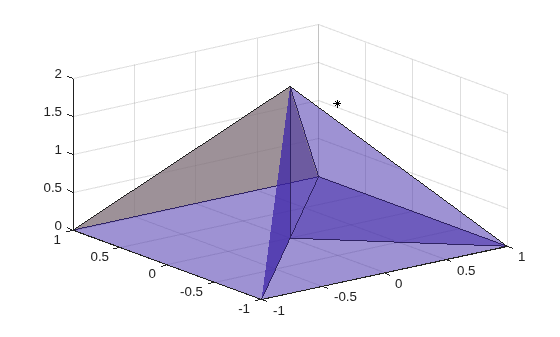
Find the coordinates of the nearest neighbor to the query point.
ID = nearestNeighbor(TR,x,y,z);
C = TR.Points(ID,:)
C = 1×3

     0     0     2
Compute the nearest neighbors in a 2-D triangulation.
Create a 2-D triangulation.
C = [5 3 1;
     3 2 1;
     3 4 2;
     4 6 2];
TP = [2.5 8.0;
      6.5 8.0;
      2.5 5.0;
      6.5 5.0;
      1.0 6.5;
      8.0 6.5];
TR = triangulation(C,TP);
Define two query points.
P = [2 4; 6 6.5];
Plot the triangulation and the query points.
triplot(TR)
hold on
plot(P(:,1),P(:,2),"k*")
ylim([1.5 8.5])
xlim([0.5 8.5])
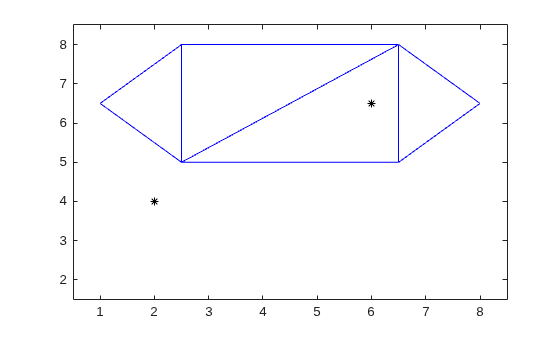
Find the nearest neighbors to the query points and the distances between them.
[ID,d] = nearestNeighbor(TR,P);
Highlight in red the points in the triangulation that are the nearest neighbors to the query points.
N = TP(ID,:);
plot(N(:,1),N(:,2),"*r")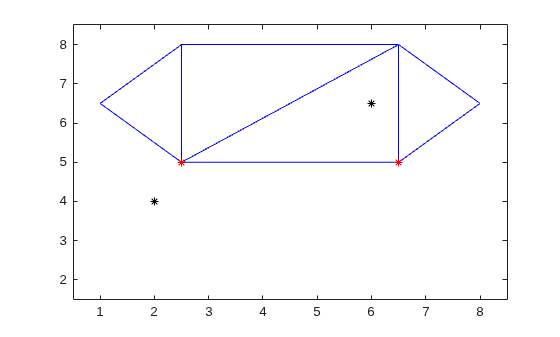
Display the distance between each query point and its nearest neighbor.
d
d = 2×1

    1.1180
    1.5811

