이 번역 페이지는 최신 내용을 담고 있지 않습니다. 최신 내용을 영문으로 보려면 여기를 클릭하십시오.
AI 검증
R2026aAI 검증 기법을 사용하여 AI 모델 및 AI 기반 시스템의 산업 표준과 규정 준수 여부를 확인해 리스크를 식별하고 완화합니다. AI Verification Library for Deep Learning Toolbox는 심층 신경망의 속성을 평가 및 검증할 수 있는 툴을 제공합니다. 예를 들면 신경망의 견고성 속성을 검증하고, 신경망 출력 범위를 계산하고, 적대적 표본을 찾고, 분포 외(out-of-distribution) 데이터를 감지하고, 산업 표준의 준수 여부를 확인할 수 있습니다. 또한 Deep Learning Toolbox Interface for alpha-beta-CROWN Verifier 지원 패키지를 사용하면 PyTorch® 신경망과 ONNX™ 신경망의 정형 검증(예: 견고성 속성 검증)을 수행할 수 있습니다.
함수
도움말 항목
알고리즘
- Verification of Neural Networks
Learn about verification of neural networks using AI Verification Library for Deep Learning Toolbox™. - Verify Robustness of Deep Learning Neural Network
This example shows how to verify the adversarial robustness of a deep learning neural network. - Verify Robustness of Imported ONNX Network
This example shows how to verify the adversarial robustness of an imported ONNX™ deep neural network. (R2024a 이후) - Out-of-Distribution Detection for Deep Neural Networks
This example shows how to detect out-of-distribution (OOD) data in deep neural networks. - Train Robust Deep Learning Network with Jacobian Regularization
Train a neural network that is robust to adversarial examples using a Jacobian regularization scheme. - GPU에서 신경망 훈련 재현하기
이 예제에서는 GPU에서 신경망을 여러 번 훈련시키고 동일한 결과를 얻는 방법을 보여줍니다. (R2024b 이후) - Uncertainty Estimation for Regression (Statistics and Machine Learning Toolbox)
Learn about estimating the uncertainty of the true response for a regression problem. - Train Custom Quantile Neural Network
This example shows how to customize and train a neural network that makes quantile predictions. (R2026a 이후) - Quantify Uncertainty in Object Detection Using Split Conformal Prediction
This example shows how to apply split conformal prediction (SCP) to an object detection model to quantify uncertainty in the predicted labels and bounding boxes. (R2026a 이후)
시계열
- 딥러닝을 사용하여 배터리 충전 상태 추정
요구 사항을 정의하고 데이터를 준비하고 딥러닝 신경망을 훈련시키고 견고성을 검증하고 신경망을 Simulink에 통합하고 모델을 배포합니다. (R2024b 이후)
- 단계 1: Define Requirements for Battery State of Charge Estimation
- 단계 2: Prepare Data for Battery State of Charge Estimation Using Deep Learning
- 단계 3: Train Deep Learning Network for Battery State of Charge Estimation
- 단계 4: Compress Deep Learning Network for Battery State of Charge Estimation
- 단계 5: Test and Verify Deep Learning Network for Battery State of Charge Estimation
- 단계 6: Integrate AI Model into Simulink for Battery State of Charge Estimation
- 단계 7: Generate Code for Battery State of Charge Estimation Using Deep Learning
- ECG Signal Classification Using Deep Learning
This example shows how to develop and verify a deep learning model that classifies electrocardiogram (ECG) signals to detect atrial fibrillation (AFib). (R2026a 이후)
- 단계 1: Define Requirements for ECG Signal Classification Using Deep Learning
- 단계 2: Prepare Data for ECG Signal Classification
- 단계 3: Train Deep Learning Network for ECG Signal Classification
- 단계 4: Improve Adversarial Robustness of Deep Learning Network for ECG Signal Classification
- 단계 5: Test Deep Learning Network for ECG Signal Classification
- 단계 6: Out-of-Distribution Detection for ECG Signal Classification
- 단계 7: Uncertainty Quantification for ECG Signal Classification
- 단계 8: Investigate ECG Signal Classifications Using Grad-CAM
- 단계 9: Build Deep Learning ECG Signal Classification App Using App Designer
테이블 형식 데이터
- Verify and Deploy Airborne Collision Avoidance System (ACAS) Xu Neural Networks
Verify a set of neural networks trained for airborne collision avoidance integrated into a Simulink model using formal methods and scenario-based closed-loop testing. (R2026a 이후)
- 단계 1: Explore ACAS Xu Neural Networks
- 단계 2: Verify Local Robustness of ACAS Xu Neural Networks
- 단계 3: Verify Global Stability of ACAS Xu Neural Networks
- 단계 4: Verify Global Stability of ACAS Xu Neural Network Using Adaptive Mesh
- 단계 5: Verify VNN-COMP Benchmark for ACAS Xu Neural Networks
- 단계 6: Verify VNN-COMP Benchmark for ACAS Xu Neural Networks Using α,β-CROWN
- 단계 7: Define and Verify AI Constituent Requirements for ACAS Xu Neural Networks
- 단계 8: Integrate ACAS Xu Neural Networks into Simulink
- 단계 9: Define and Verify AI System Requirements for ACAS Xu Neural Networks Integrated Into Simulink
비전
- Generate Untargeted and Targeted Adversarial Examples for Image Classification
This example shows how to use the fast gradient sign method (FGSM) and the basic iterative method (BIM) to generate adversarial examples for a pretrained neural network. - Train Image Classification Network Robust to Adversarial Examples
This example shows how to train a neural network that is robust to adversarial examples using fast gradient sign method (FGSM) adversarial training. - Generate Adversarial Examples for Semantic Segmentation
This example shows how to generate adversarial examples for a semantic segmentation network using the basic iterative method (BIM). - Out-of-Distribution Data Discriminator for YOLO v4 Object Detector
This example shows how to detect out-of-distribution (OOD) data in a YOLO v4 object detector. - Verify an Airborne Deep Learning System
This example shows how to verify a deep learning system for airborne applications and is based on the work in [5,6,7], which includes the development and verification activities required by DO-178C [1], ARP4754A [2], and prospective EASA and FAA guidelines [3,4]. (R2023b 이후)
텍스트
- Out-of-Distribution Detection for BERT Document Classifier
This example shows how to detect out-of-distribution data for a BERT document classifier. (R2024b 이후) - Out-of-Distribution Detection for LSTM Document Classifier
This example shows how to detect out-of-distribution (OOD) data in an LSTM document classifier. (R2024a 이후)
인증 워크플로
- Runway Sign Classifier: Certify an Airborne Deep Learning System (DO Qualification Kit)
Demonstrates the certification of airborne deep learning system.
추천 예제
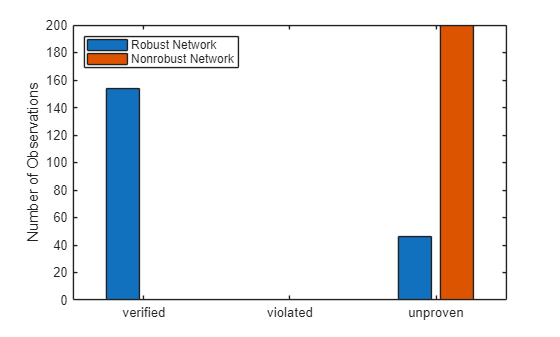
Verify Robustness of Deep Learning Neural Network
Verify the adversarial robustness of a deep learning neural network.
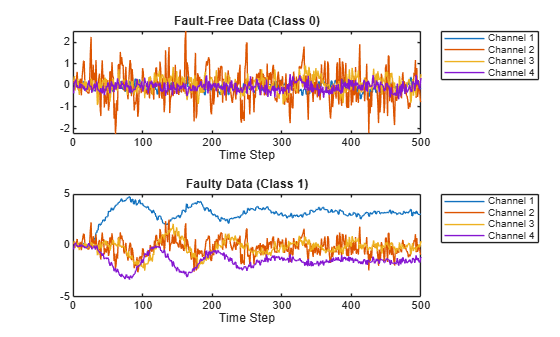
Out-of-Distribution Detection for Deep Neural Networks
Detect out-of-distribution (OOD) data in deep neural networks.
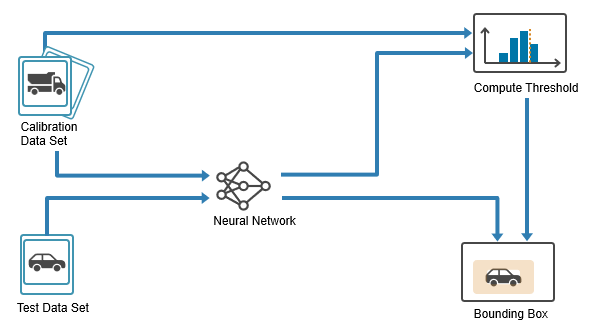
Quantify Uncertainty in Object Detection Using Split Conformal Prediction
Apply split conformal prediction (SCP) to an object detection model to quantify uncertainty in the predicted labels and bounding boxes.
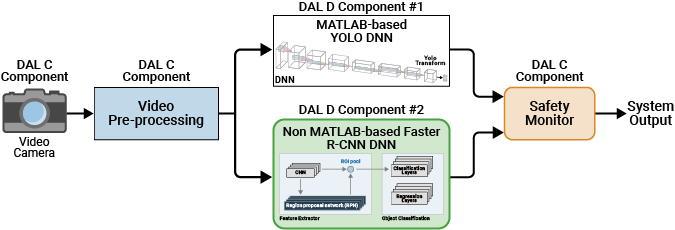
Verify an Airborne Deep Learning System
Verify a deep learning system for airborne applications and is based on the work in [5,6,7], which includes the development and verification activities required by DO-178C [1], ARP4754A [2], and prospective EASA and FAA guidelines [3,4]. To verify that the system complies with aviation industry standards and prospective guidelines, including activities such as requirements tracing, testing and reporting, see Runway Sign Classifier: Certify an Airborne Deep Learning System (DO Qualification Kit).
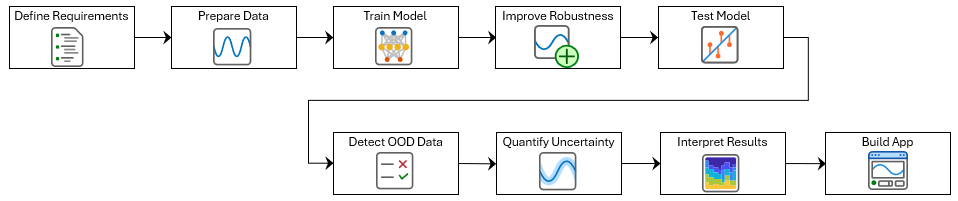
ECG Signal Classification Using Deep Learning
Develop and verify a deep learning model that classifies electrocardiogram (ECG) signals to detect atrial fibrillation (AFib). The example guides you through a complete workflow for building an AI system, with a focus on robustness, explainability, and verification against defined requirements.
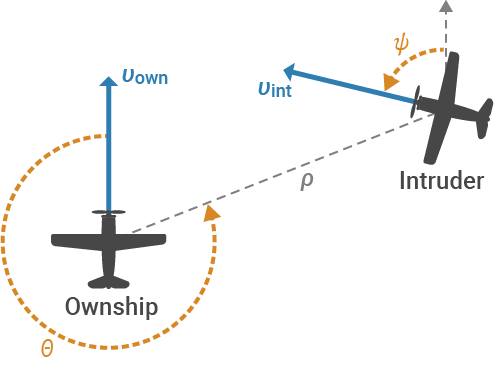
Verify and Deploy Airborne Collision Avoidance System (ACAS) Xu Neural Networks
Verify a set of neural networks trained for airborne collision avoidance integrated into a Simulink model using formal methods and scenario-based closed-loop testing.

