Rotating Cylinder Force (IL)
R2026bCentripetal pressure gradient for components in an isothermal liquid system
Rotating Cylinder Force (IL) block
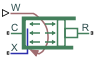
To add a block to a model, double-click the canvas and start typing the block name. Then, select the block from the list.
Libraries:
Simscape /
Fluids /
Isothermal Liquid /
Actuators /
Auxiliary Components
Description
The Rotating Cylinder Force (IL) block models the axial force due to a centripetal pressure gradient in a rotating shaft about its symmetry axis, which is found in applications such as friction clutches, square-jaw positive clutches, dog clutches, and brakes. Connect this block in parallel to a Single-Acting Actuator (IL) or a Translational Mechanical Converter (IL) block to model a rotating actuator. The fluid density is recorded at the isothermal liquid port X. The angular velocity is received as a physical signal at port W. Port R is associated with the piston velocity, relative to the case at port C.
The angular velocity of the shaft is assumed to be constant or nearly-constant, and therefore the fluid is considered to be in rigid-body rotation.
The centripetal force is due solely to the fluid angular momentum induced by shaft rotation. Removing the contribution of the static pressure in the fluid channel, the contribution of the rotation of the shaft to the axial force is:
where:
ρ is the fluid density at port X.
W is the angular velocity of the rotating pipe, received as a physical signal at port W.
ro is the Piston outer radius.
ri is the Piston inner radius.
rp is the Fluid entry radius.
Ports
Conserving
Input
Parameters
Programmatic Use: Add Block
To add the block programmatically, use the add_block function with one of these library block paths as the source.
"SimscapeFluids_lib/Isothermal Liquid/Actuators/Auxiliary Components/Rotating
    Cylinder Force (IL)"
Example: add_block("SimscapeFluids_lib/Isothermal Liquid/Actuators/Auxiliary Components/Rotating
Cylinder Force (IL)","myModel/myBlock",MakeNameUnique="on")
For information about programmatic access to individual block parameters, see the Programmatic Use section of parameter descriptions on this page.
Extended Capabilities
Version History
Introduced in R2020a

