이 제출물을 팔로우합니다
- 팔로우하는 게시물 피드에서 업데이트를 확인할 수 있습니다
- 정보 수신 기본 설정에 따라 이메일을 받을 수 있습니다
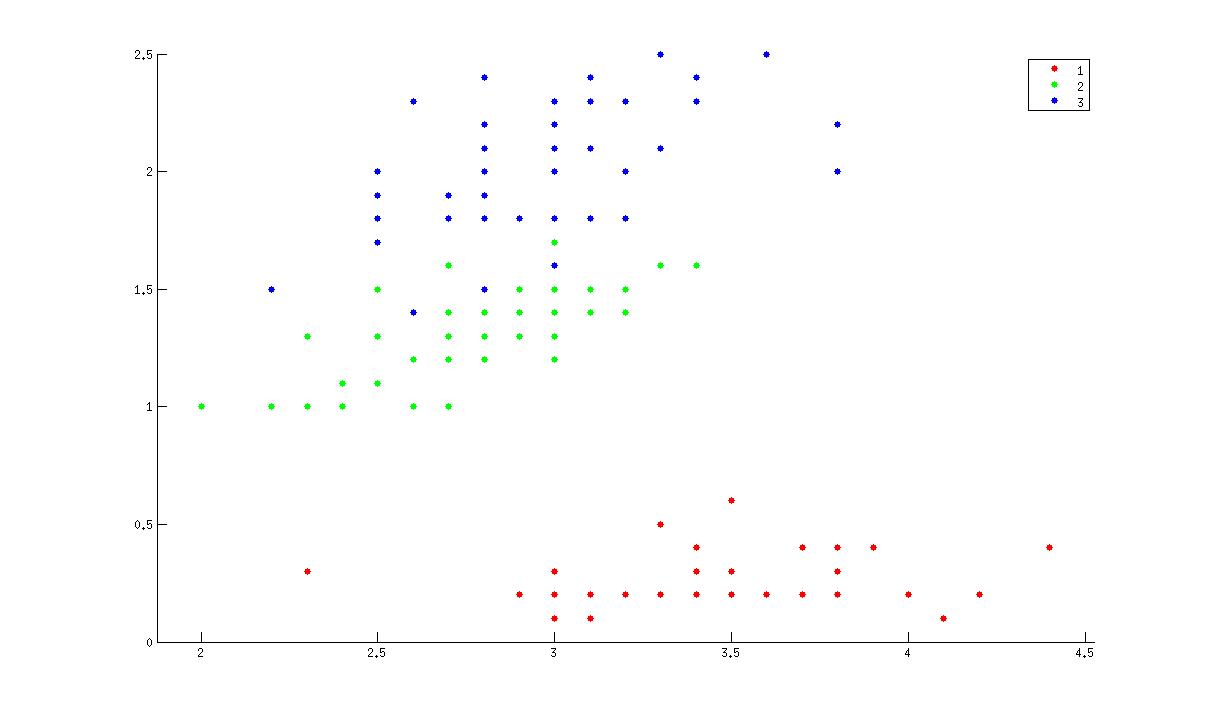
% 1: Load iris.mat file which contains Iris data and its label
% seperately.
% 2: Randomize the order of data for each iternation so that new sets of
% training and test data are formed.
%
% The training data is of having size of Nxd where N is the number of
% measurements and d is the number of variables of the training data.
%
% Similarly the size of the test data is Mxd where M is the number of
% measurements and d is the number of variables of the test data.
% 3: For each observation in test data, we compute the euclidean distance
% from each obeservation in training data.
% 4: We evalutate 'k' nearest neighbours among them and store it in an
% array.
% 5: We apply the label for which distance is minimum
% 5.1: In case of a tie, we randomly label the class.
% 6: Return the class label.
% 7: Compute confusion matrix.
인용 양식
lavya Gavshinde (2026). 4-Nearest Neighbor on iris recognition using randomized partitioning. (https://kr.mathworks.com/matlabcentral/fileexchange/37827-4-nearest-neighbor-on-iris-recognition-using-randomized-partitioning), MATLAB Central File Exchange. 검색 날짜: .
도움
도움 받은 파일: K Nearest Neighbors
| 버전 | 퍼블리시됨 | 릴리스 정보 | Action |
|---|---|---|---|
| 1.0.0.0 |
