wlanVHTLTFChannelEstimate
R2026bChannel estimation using VHT-LTF
Syntax
Description
chanEst = wlanVHTLTFChannelEstimate(demodSig,cfg)demodSig, given the
parameters specified in wlanVHTConfig object
cfg.
[
returns the channel estimate at each pilot subcarrier
location for each demodulated VHT-LTF symbol in addition to
any input argument combination from the previous syntaxes.
The function assumes that there is one space-time stream at
the transmitter.chanEst,chanEstSSPilots] = wlanVHTLTFChannelEstimate(___)
Examples
Create a VHT format configuration object. Generate a VHT waveform based on cfg. Isolate the VHT-LTF field.
cfg = wlanVHTConfig(ChannelBandwidth="CBW20");
txSig = wlanWaveformGenerator(1,cfg);
ind = wlanFieldIndices(cfg,"VHT-LTF");
Multiply the transmitted VHT-LTF signal by 0.3 – 0.15i and pass it through an AWGN channel having a 30 dB signal-to-noise ratio. Demodulate the received signal.
rxSig = awgn(txSig*(0.3-0.15i),30);
rxSig = rxSig(ind(1):ind(2),:);
demodSig = wlanVHTDemodulate(rxSig,'VHT-LTF',cfg);
Estimate the channel response using the demodulated VHT-LTF signal.
chanEst = wlanVHTLTFChannelEstimate(demodSig,cfg);
Plot the channel estimate.
scatterplot(chanEst)
grid
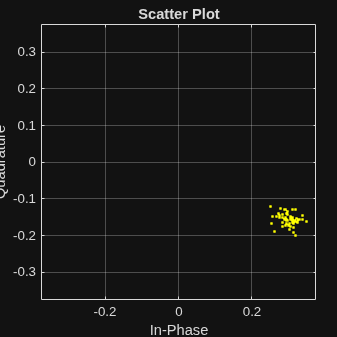
The channel estimate matches the complex channel multiplier.
Estimate and display the channel coefficients of a 4x2 MIMO channel using the VHT-LTF.
Create a VHT format configuration object for a channel having four spatial streams and four transmit antennas. Transmit a complete VHT waveform.
cfg = wlanVHTConfig('NumTransmitAntennas',4, ...
    'NumSpaceTimeStreams',4,'MCS',5);
txWaveform = wlanWaveformGenerator([1;0;0;1;1;0],cfg);
Set the sampling rate, and then pass the transmitted waveform through a 4x2 TGac channel.
fs = 80e6;
tgacChan = wlanTGacChannel('SampleRate',fs, ...
    'NumTransmitAntennas',4,'NumReceiveAntennas',2);
rxWaveform = tgacChan(txWaveform);
Determine the VHT-LTF field indices and demodulate the VHT-LTF from the received waveform.
indVHTLTF = wlanFieldIndices(cfg,'VHT-LTF');
ltfDemodSig = wlanVHTDemodulate(rxWaveform(indVHTLTF(1):indVHTLTF(2),:),'VHT-LTF',cfg);
Generate the channel estimate by using the demodulated VHT-LTF signal. Specify a smoothing filter span of five subcarriers.
[chanEst,chanEstSSPilots] = wlanVHTLTFChannelEstimate(ltfDemodSig,cfg,5);
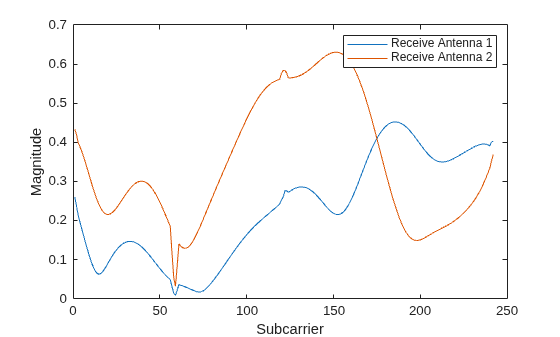
Plot the magnitude response of the first space-time stream for both receive antennas. Due to the random nature of the fading channel, your results may vary.
plot(abs(chanEst(:,1,1)))
hold on
plot(abs(chanEst(:,1,2)))
xlabel('Subcarrier')
ylabel('Magnitude')
legend('Receive Antenna 1','Receive Antenna 2')
Input Arguments
Output Arguments
More About
References
[1] IEEE Std 802.11-2020 (Revision of IEEE Std 802.11-2016). “Part 11: Wireless LAN Medium Access Control (MAC) and Physical Layer (PHY) Specifications.” IEEE Standard for Information Technology — Telecommunications and Information Exchange between Systems — Local and Metropolitan Area Networks — Specific Requirements.
[2] IEEE Std 802.11™-2012 IEEE Standard for Information technology — Telecommunications and information exchange between systems — Local and metropolitan area networks — Specific requirements — Part 11: Wireless LAN Medium Access Control (MAC) and Physical Layer (PHY) Specifications.
[3] Perahia, E., and R. Stacey. Next Generation Wireless LANs: 802.11n and 802.11ac. 2nd Edition, United Kingdom: Cambridge University Press, 2013.
Extended Capabilities
Version History
Introduced in R2015bSee Also
1 IEEE Std 802.11-2020 Adapted and reprinted with permission from IEEE. Copyright IEEE 2020. All rights reserved.

