이 번역 페이지는 최신 내용을 담고 있지 않습니다. 최신 내용을 영문으로 보려면 여기를 클릭하십시오.
Hammerstein-Wiener 모델
R2026a정적 비선형성을 제외하면 선형 시스템이 되는 시스템에서 Hammerstein-Wiener 모델로 정적 비선형성을 추정합니다. Hammerstein-Wiener 구조체를 사용하여 선형 시스템의 입력 및 출력(예: 불감대 및 포화)에 영향을 미치는 센서 및 액추에이터의 물리적 비선형 효과를 캡처할 수 있습니다. Hammerstein-Wiener 모델을 추정하려면 System Identification 앱 또는 nlhw 함수를 사용하십시오.
앱
| System Identification | 측정된 데이터에서 동적 시스템의 모델 식별하기 |
함수
블록
 | Hammerstein-Wiener Model | Simulate Hammerstein-Wiener model in Simulink software |
 | Iddata Sink | 시뮬레이션 데이터를 iddata 객체로 MATLAB 작업 공간으로 내보내기 |
 | Iddata Source | Import time-domain data stored in iddata object in
MATLAB workspace |
도움말 항목
- What Are Hammerstein-Wiener Models?
Understand the structure of Hammerstein-Wiener models.
- Available Nonlinearity Estimators for Hammerstein-Wiener Models
Choose from a set of scalar nonlinearity estimators that you can use for both input and output estimators in Hammerstein-Wiener models.
- Identifying Hammerstein-Wiener Models
Specify the Hammerstein-Wiener model structure, and configure the estimation algorithm.
- Validating Hammerstein-Wiener Models
Plot model nonlinearities, analyze residuals, and simulate model output.
- Using Hammerstein-Wiener Models
Simulate and predict model output, linearize Hammerstein-Wiener models, and import estimated models into the Simulink® software.
- Linear Approximation of Nonlinear Black-Box Models
Choose the approach for computing linear approximations, compute operating points for linearization, and linearize your model.
- How the Software Computes Hammerstein-Wiener Model Output
How the software evaluates the output of nonlinearity estimators and uses this output to compute the model response.
추천 예제
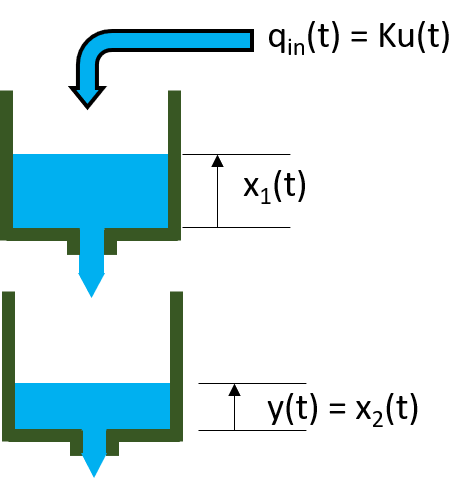
A Tutorial on Identification of Nonlinear ARX and Hammerstein-Wiener Models
Identify single-input-single-output (SISO) nonlinear black box models using measured input-output data.
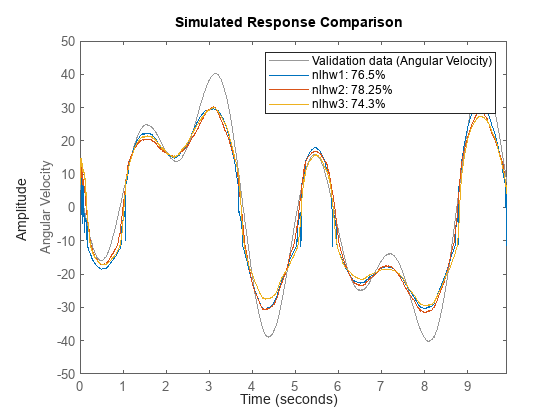
Create Black-Box Models of a Robotic Arm System Using Neural Networks
Use neural networks as the nonlinear function when you model nonlinear ARX and Hammerstein-Wiener models. It compares the nonlinear systems estimated using different types of neural networks, activation functions, and number of layers.

Hammerstein-Wiener Model of SI Engine Torque Dynamics
Describes modeling the nonlinear torque dynamics of a spark-ignition (SI) engine as a Hammerstein-Wiener model. The identified model can be used for hardware-in-the-loop (HIL) testing, powertrain control, diagnostic, and training algorithm design. For example, you can use the model for aftertreatment control and diagnostics algorithm development. For more information on Hammerstein-Wiener models, see Hammerstein-Wiener Models.

