Kinematic Aerospace Actor
R2026bKinematic Aerospace Actor block
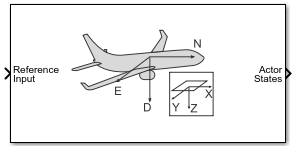
To add a block to a model, double-click the canvas and start typing the block name. Then, select the block from the list.
Libraries:
Aerospace Blockset /
Integrated Systems /
Actor Models
Description
The Kinematic Aerospace Actor block models the translational and rotational motion of aerospace and surface vehicles using kinematic equations with configurable controller and sensor specifications. The block supports fixed‑wing aircraft agile aerial vehicles and surface vehicles, with multiple navigation frames and unit systems for system‑level, low‑fidelity simulation of vehicle motion, onboard inertial sensing, and basic target tracking without explicit aerodynamics or propulsion modeling.
The block integrates vehicle kinematics, controller response dynamics (first‑ or second‑order, or external), and optional sensor models directly within a single actor representation. This integration simplifies multi‑vehicle simulation workflows by reducing manual wiring and ensuring consistent timing and frame transformations.
Ports
Input
Reference inputs corresponding to the ideal vehicle trajectory, specified as a nonvirtual bus. The bus elements depend on the Actor type and Actor reference signal configuration.
This table lists the expected bus elements for each actor type and reference signal selection.
| Actor Type | Reference Selection | Bus Elements |
|---|---|---|
Fixed Wing | {'SpeedRef', 'FPARef', 'HeadingRef'} | Speed, Flight Path Angle, Heading |
{'SpeedRef', 'FPARef', 'BankRef'} | Speed, Flight Path Angle, Bank Angle | |
Agile Aerial Vehicle | {'SpeedRef', 'LateralAccRef', 'VerticalAccRef'} | Speed, Lateral Acceleration, Vertical Acceleration |
Surface Vehicle | {'SpeedRef', 'HeadingRef'} | Speed, Heading Angle |
Each bus element must be a scalar signal of type double.
You can assign any name to the bus object and signals.
Dependencies
This port is available when Controller
behavior is set to General
GNC.
Control inputs provided by an external controller, specified as a nonvirtual bus. The bus contains the body accelerations and angular rate signals of the vehicle. These signals are analogous to applied forces and moments and are treated as direct control inputs.
This table lists the expected bus elements for each actor type and control input selection.
| Actor Type | Control Input Selection | Bus Elements |
|---|---|---|
Fixed Wing | {'LongitudinalAcc', 'PitchRate', 'TurnRate'} | Longitudinal Acceleration, Pitch Rate, Turn Rate |
{'LongitudinalAcc', 'PitchRate', 'RollRate'} | Longitudinal Acceleration, Pitch Rate, Roll Rate | |
Agile Aerial Vehicle | {'LongitudinalAcc', 'LateralAcc', 'VerticalAcc'} | Longitudinal Acceleration, Lateral Acceleration, Vertical Acceleration |
Surface Vehicle | {'LongitudinalAcc', 'TurnRate'} | Longitudinal Acceleration, Turn Rate |
Each bus element must be a scalar signal of type double.
You can assign any name to the bus object and signals.
Dependencies
This port is available when Controller
behavior is set to
External Controller.
Mount attitude input that enables the user to provide the mount attitude for modelling a gimbal tracker, specified as a nonvirtual bus. The angles represent the attitude of the tracker relative to the vehicle body frame, specified as a [roll, pitch, yaw] vector using Z‑Y‑X intrinsic Euler rotation.
Expected bus elements: Roll, Pitch, Yaw. Each bus element must
be a scalar signal of type double. You can
assign any name to the bus object and signals. Units are configured
through the Attitude units parameter.
Dependencies
This port is available when Mount
type is set to
Gimbal.
Concatenated state signals from other
Kinematic Aerospace Actor blocks, specified as an array of
nonvirtual buses. Each bus element represents the actor states of one
target vehicle and must match the Actor States
output bus definition. Each bus element must be a scalar signal of type
double.
Note
It is recommended to use a Unit Delay if feeding back multiple actor's states causes an algebraic loop.
Dependencies
This port is available when Detection type is set to Tracker.
Output
Vehicle position, orientation, and speed expressed in the selected navigation frame, specified as a nonvirtual bus. The bus definition is specified in the Signal Attributes tab and must contain scalar double elements in the defined sequence.
This table lists the expected bus elements for each navigation frame selection.
| Navigation Frame | Bus Elements |
|---|---|
Flat Earth | X, Y, Z, Roll, Pitch, Heading, Speed |
ECEF Frame | Latitude, Longitude, Altitude, Roll, Pitch, Heading, Speed |
WGS84 Ellipsoid | X, Y, Z, Roll, Pitch, Heading, Speed |
Flat Earth assumes the NED frame for Fixed Wing
and Agile Aerial Vehicle and the ENU frame for
Surface Vehicle.
Linear accelerations and attitude rates of the actor expressed in the
inertial sensor frame, specified as a nonvirtual bus of scalar
double signals. Measurements are computed at the
specified inertial sensor offset from the center of gravity.
The bus contains these elements:
Body-frame acceleration along the X axis
Body-frame acceleration along the Y axis
Body-frame acceleration along the Z axis
Yaw rate
Pitch rate
Roll rate
Dependencies
This port is available when Output inertial sensor
measurements is set to true.
Detection measurements corresponding to each target actor provided at
the Target States input, specified as an array of
nonvirtual buses of scalar double signals. The number
of output buses matches the number of input target state buses, and each
bus contains the detection results for one target.
The bus elements depend on the selected Tracker measurement coordinates.
Note
If a target is outside the detectable region (undetectable), the signals in the corresponding bus in tracker measurement will be NaN.
| Coordinate System | Bus Elements |
|---|---|
Sensor Frame | Range, Azimuth, Elevation |
Flat Earth | X, Y, Z |
ECEF Frame | X, Y, Z |
WGS84 Ellipsoid | Latitude, Longitude, Altitude |
Dependencies
This port is available when Detection type is set to Tracker.
Parameters
To edit block parameters interactively, use the Property Inspector. From the Simulink® Toolstrip, on the Simulation tab, in the Prepare gallery, select Property Inspector.
Main
Input and output ports and parameter units, specified as
Metric (MKS), English (velocity in ft/s), or
English (velocity in kts).
| Units | Length | Velocity | Acceleration |
|---|---|---|---|
Metric (MKS)
| m | m/s | m/s2 |
English (velocity in ft/s)
| ft | ft/s | ft/s2 |
English (velocity in kts)
| ft | kts | ft/s2 |
Programmatic Use
Block Parameter:
units |
| Type: character vector |
Values:
Metric (MKS) |
English (velocity in ft/s) |
English (velocity in kts) |
Default:
Metric (MKS) |
Units used for all angular positions and angular rates
except latitude and longitude, specified as
Degrees |
Radians. Latitude and longitude are
always in degrees.
Programmatic Use
Block Parameter:
attitudeUnits |
| Type: character vector |
Values:
Degrees |
Radians |
Default:
Degrees |
Type of vehicle modeled by the block, specified as Fixed
Wing, Agile Aerial Vehicle
or Surface Vehicle.
Programmatic Use
Block Parameter:
actorType |
| Type: character vector |
Values:
Fixed Wing | Agile
Aerial Vehicle | Surface
Vehicle |
Default:
Fixed Wing |
Navigation frame used to express position states, specified as
Flat Earth, ECEF
Frame or WGS84
Ellipsoid.
Programmatic Use
Block Parameter:
actorFrame |
| Type: character vector |
Values:
Flat Earth | ECEF
Frame | WGS84
Ellipsoid |
Default:
Flat Earth |
Initial States
Initial position of actor vehicle in Cartesian coordinates, specified as a 1-by-2 real vector in meters or feet.
Dependencies
This parameter is available when Navigation
frame is set to Flat
Earth or ECEF
Frame.
Programmatic Use
Block Parameter:
actorInitialXY |
| Type: real vector |
Values:
[0,0] | real
vector |
Default:
[0,0] |
Initial latitude of the actor in polar coordinates, specified as a real scalar in degrees.
Dependencies
This parameter is available when Navigation
frame is set to WGS84
Ellipsoid.
Programmatic Use
Block Parameter:
actorInitialLatitude |
| Type: real scalar |
Values:
0 | real scalar |
Default:
0 |
Initial longitude of the actor in polar coordinates, specified as a real scalar in degrees.
Dependencies
This parameter is available when Navigation
frame is set to WGS84
Ellipsoid.
Programmatic Use
Block Parameter:
actorInitialLongitude |
| Type: real scalar |
Values:
0 | real scalar |
Default:
0 |
Initial altitude of the actor, specified as a real scalar in meters or feet.
Dependencies
This parameter is available when Navigation
frame is set to WGS84
Ellipsoid or Flat
Earth.
Programmatic Use
Block Parameter:
actorInitialAltitude |
| Type: real scalar |
Values:
0 | real scalar |
Default:
0 |
Initial position of actor vehicle in Cartesian coordinates, specified as a real scalar in meters or feet.
Dependencies
This parameter is available when Navigation
frame is set to ECEF
Frame.
Default Values
The default value of this parameter is the approximate Z value at X=0, Y=0 on Earth's surface, obtained using this command:
lla2ecef([90 0 0])
Programmatic Use
Block Parameter:
actorInitialZ |
| Type: real scalar |
Values:lla2ecef([90 0 0])
real scalar |
Default:
lla2ecef([90 0 0]) |
Initial attitude of the actor specified as a 3-by-1 vector in degrees or radians, representing [roll, pitch, yaw]. The vector corresponds to Z->Y->X intrinsic Euler rotation, transforming from the navigation frame to the vehicle’s body frame.
Dependencies
This parameter is available when Actor
Type is set to Fixed
Wing or Agile Aerial
Vehicle.
Programmatic Use
Block Parameter:
actorInitialAttitude |
| Type: real vector |
Values:
[0,0, 0] | real
vector |
Default:
[0,0, 0] |
Initial heading of the actor as a Z Euler rotation with respect to the navigation frame, specified as a real scalar.
Dependencies
This parameter is available when Actor
Type is set to Surface
Vehicle. The Kinematic Aerospace Actor assumes
that the surface vehicle travels on a surface of constant
altitude.
Programmatic Use
Block Parameter:
actorInitialHeading |
| Type: real scalar |
Values:
0 | real scalar |
Default:
0 |
Initial speed of the actor, specified as a real non-negative scalar in m/s, ft/s, or kts.
Programmatic Use
Block Parameter:
actorInitialSpeed |
| Type: double |
Values:
10 | real
scalar |
Default:
10 |
GNC
Select the type of controller for the actor defined in
Actor type, specified as
General GNC or External
Controller. When set to General
GNC, the block uses an internal first‑ or second‑order
controller to track the reference input signals. When set to
External Controller, you can manage the
controller outside the block and provide control signals directly
through the Control Input port.
Programmatic Use
Block Parameter:
controllerBehavior |
| Type: double |
Values:
General GNC | External
Controller |
Default:
General GNC |
Element combination for the input reference
signal, specified as {'SpeedRef', 'FPARef',
'HeadingRef'} or {'SpeedRef', 'FPARef',
'BankRef'}.
Dependencies
This parameter is available when Actor
Type is set to Fixed
Wing and Controller
behavior is set to General
GNC.
Note
Only one of the Actor reference signal parameters is visible at a time depending on the value of the Actor type parameter.
Programmatic Use
Block Parameter:
fixedWingReferenceInput |
| Type: character vector |
Values:
{'SpeedRef', 'FPARef', 'HeadingRef'}
| {'SpeedRef', 'FPARef',
'BankRef'} |
Default:
{'SpeedRef', 'FPARef',
'HeadingRef'} |
Element combination for the input reference
signal, specified as {'SpeedRef', 'LateralAccRef',
'VerticalAccRef'}.
Dependencies
This parameter is not editable but visible when the
Actor Type is set to
Agile Aerial Vehicle and
Controller behavior is set to
General GNC.
Note
Only one of the Actor reference signal parameters is visible at a time depending on the value of the Actor type parameter.
Programmatic Use
Block Parameter:
agileAerialVehicleReferenceInput |
| Type: character vector |
Values:
{'SpeedRef', 'LateralAccRef',
'VerticalAccRef'}
|
Default:
{'SpeedRef', 'LateralAccRef',
'VerticalAccRef'} |
Element combination for the input reference
signal, specified as {'SpeedRef',
'HeadingRef'}.
Dependencies
This parameter is not editable but visible when the
Actor Type is set to
Surface Vehicle and
Controller behavior is set to
General GNC.
Note
Only one of the Actor reference signal parameters is visible at a time depending on the value of the Actor type parameter.
Programmatic Use
Block Parameter:
surfaceVehicleReferenceInput |
| Type: character vector |
Values:
{'SpeedRef', 'HeadingRef'}
|
Default:
{'SpeedRef', 'HeadingRef'} |
Element combination for input from external
controller, specified as {'LongitudinalAcc',
'PitchRate', 'TurnRate'} or
{'LongitudinalAcc', 'PitchRate',
'RollRate'}.
Dependencies
This parameter is available when the
Actor Type is set to
Fixed Wing and Controller
behavior is set to External
Controller.
Note
Only one of the Actor control input
parameters is visible at a time depending on the value of
the Actor type parameter. This
parameter is disabled for Agile Aerial
Vehicle and Surface
Vehicle actor types.
Programmatic Use
Block Parameter:
fixedWingControlInput |
| Type: character vector |
Values:
{'LongitudinalAcc', 'PitchRate',
'TurnRate'} | {'LongitudinalAcc',
'PitchRate', 'RollRate'}
|
Default:
{'LongitudinalAcc', 'PitchRate',
'TurnRate'} |
Element combination for input from external
controller, specified as {'LongitudinalAcc', 'LateralAcc',
'VerticalAcc'}.
Dependencies
This parameter is not editable but visible when the
Actor Type is set to
Agile Aerial Vehicle and
Controller behavior is set to
External Controller.
Note
Only one of the Actor control input parameters is visible at a time depending on the value of the Actor type parameter.
Programmatic Use
Block Parameter:
agileAerialVehicleControlInput |
| Type: character vector |
Values:
{'LongitudinalAcc', 'LateralAcc',
'VerticalAcc'} |
Default:
{'LongitudinalAcc', 'LateralAcc',
'VerticalAcc'} |
Element combination for input from external
controller, specified as {'LongitudinalAcc',
'TurnRate'}.
Dependencies
This parameter is not editable but visible when the
Actor Type is set to
Surface Vehicle and
Controller behavior is set to
External Controller.
Note
Only one of the Actor control input parameters is visible at a time depending on the value of the Actor type parameter.
Programmatic Use
Block Parameter:
surfaceVehicleControlInput |
| Type: character vector |
Values:
{'LongitudinalAcc',
'TurnRate'} |
Default:
{'LongitudinalAcc',
'TurnRate'} |
Speed Response Parameters
Order of the speed controller subsystem, specified as
First order or Second
order.
Dependencies
This parameter is available when Controller
behavior is set to General
GNC.
Programmatic Use
Block Parameter:
speedOrder |
| Type: character vector |
Values:
First order | Second order |
Default:
First order |
Speed DC gain for fixed-wing vehicle, specified as a real positive scalar.
Dependencies
This parameter is available when Controller
behavior is set to General
GNC.
Programmatic Use
Block Parameter:
speedDCGain |
| Type: double |
Values:
1 | real positive
scalar |
Default:
1 |
Speed time constant of the controller subsystem, specified as a real positive scalar in seconds.
Dependencies
This parameter is available when
Controller behavior is set to
General GNC.Speed is set to
First order.
Programmatic Use
Block Parameter:
speedTimeConstant |
| Type: double |
Values:
1 | real positive
scalar |
Default:
1 |
Speed natural frequency of the controller subsystem, specified as a real positive scalar in rad/s.
Dependencies
Controller behavior is set to
General GNC.Speed is set to
Second order.
Programmatic Use
Block Parameter:
speedNaturalFrequency |
| Type: double |
Values:
1 | real positive
scalar |
Default:
1 |
Speed damping ratio of the controller subsystem, specified as a real positive scalar (dimensionless).
Dependencies
Controller behavior is set to
General GNC.Speed is set to
Second order.
Programmatic Use
Block Parameter:
speedDampingRatio |
| Type: double |
Values:
1 | real positive
scalar |
Default:
1 |
Speed Limits
Minimum speed, specified as a real non-negative scalar.
Note
The value of Speed min must be less than or equal to the value of Speed max.
Dependencies
This parameter is available when Controller
behavior is set to General
GNC. The unit of speed is m/s, ft/s, or kts based on the value of the
Units parameter.
Programmatic Use
Block Parameter:
speedMin |
| Type: double |
Values:
0
|
Default:
0 |
Maximum speed, specified as a real positive scalar.
Note
The value of Speed max must be greater than or equal to the value of Speed min.
Dependencies
This parameter is available when Controller
behavior is set to General
GNC. The unit of speed is m/s, ft/s, or kts based on the value of the
Units parameter.
Programmatic Use
Block Parameter:
speedMax |
| Type: double |
Values:
Inf | real positive
scalar |
Default:
Inf |
Flight Path Angle Parameters
Order of the FPA controller subsystem, specified as
First order or Second
order.
Dependencies
This parameter is available when
Actor type is set to
Fixed Wing.Controller behavior is set to
General GNC.
Programmatic Use
Block Parameter:
FPAOrder |
| Type: character vector |
Values:
First order | Second order |
Default:
First order |
FPA DC gain for fixed-wing vehicle, specified as a real positive scalar.
Dependencies
Actor Type is set to
Fixed Wing.Controller behavior is set to
General GNC.
Programmatic Use
Block Parameter:
FPADCGain |
| Type: double |
Values:
1 | real positive
scalar |
Default:
1 |
FPA time constant of the controller subsystem, specified as a real positive scalar in seconds.
Dependencies
Actor Type is set to
Fixed Wing.Controller behavior is set to
General GNC.FPA is set to
First order.
Programmatic Use
Block Parameter:
FPATimeConstant |
| Type: double |
Values:
1 | real positive
scalar |
Default:
1 |
FPA natural frequency of the controller subsystem, specified as a real positive scalar in rad/s.
Dependencies
Actor Type is set to
Fixed Wing.Controller behavior is set to
General GNC.FPA is set to
Second order.
Programmatic Use
Block Parameter:
FPANaturalFrequency |
| Type: double |
Values:
1 | real positive
scalar |
Default:
1 |
FPA damping ratio of the controller subsystem, specified as a real positive scalar (dimensionless).
Dependencies
Actor Type is set to
Fixed Wing.Controller behavior is set to
General GNC.FPA is set to
Second order.
Programmatic Use
Block Parameter:
FPADampingRatio |
| Type: double |
Values:
1 | real positive
scalar |
Default:
1 |
Flight Path Angle Limits
Minimum FPA, specified as an angle in the range [-π π] rad or [-180 180] deg.
Note
The value of FPA min must be less than or equal to the value of FPA max.
Dependencies
This parameter is available when:
Actor type is set to
Fixed Wing.Controller behavior is set to
General GNC.
Programmatic Use
Block Parameter:
FPAMin |
| Type: double |
Values:
-45 | real scalar |
Default:
-45 |
Maximum FPA, specified as an angle in the range [-π π] rad or [-180 180] deg.
Note
The value of FPA min must be less than or equal to the value of FPA max.
Dependencies
This parameter is available when:
Actor type is set to
Fixed Wing.Controller behavior is set to
General GNC.
Programmatic Use
Block Parameter:
FPAMax |
| Type: double |
Values:
45 | real scalar |
Default:
45 |
Heading Response Parameters
Order of the heading controller subsystem, specified as
First order or Second
order.
Dependencies
This parameter is available when
Actor type is set to
Fixed WingorSurface Vehicle.Controller behavior is set to
General GNC.Actor reference signal is set to
{'SpeedRef', 'FPARef', 'HeadingRef'}when Actor Type isFixed Wing.
Programmatic Use
Block Parameter:
headingOrder |
| Type: character vector |
Values:
First order | Second order |
Default:
First order |
Heading DC gain for fixed-wing vehicle, specified as a real positive scalar.
Dependencies
This parameter is available when:
Actor Type is set to
Fixed WingorSurface Vehicle.Controller behavior is set to
General GNC.Actor reference signal is set to
{'SpeedRef', 'FPARef', 'HeadingRef'}when Actor Type isFixed Wing.
Programmatic Use
Block Parameter:
headingDCGain |
| Type: double |
Values:
1 | real positive
scalar |
Default:
1 |
Heading time constant of the controller subsystem, specified as a real positive scalar in seconds.
Dependencies
This parameter is available when:
Actor Type is set to
Fixed WingorSurface Vehicle.Controller behavior is set to
General GNC.Heading is set to
First order.Actor reference signal is set to
{'SpeedRef', 'FPARef', 'HeadingRef'}when Actor Type isFixed Wing.
Programmatic Use
Block Parameter:
headingTimeConstant |
| Type: double |
Values:
1 | real positive
scalar |
Default:
1 |
Heading natural frequency of the controller subsystem, specified as a real positive scalar in rad/s.
Dependencies
This parameter is available when:
Actor Type is set to
Fixed WingorSurface Vehicle.Controller behavior is set to
General GNC.Actor reference signal is set to
{'SpeedRef', 'FPARef', 'HeadingRef'}when Actor Type isFixed Wing.Heading is set to
Second order.
Programmatic Use
Block Parameter:
headingNaturalFrequency |
| Type: double |
Values:
1 | real positive
scalar |
Default:
1 |
Heading damping ratio of the controller subsystem, specified as a real positive scalar (dimensionless).
Dependencies
Actor Type is set to
Fixed WingorSurface Vehicle.Controller behavior is set to
General GNC.Actor reference signal is set to
{'SpeedRef', 'FPARef', 'HeadingRef'}when Actor Type isFixed Wing.Heading is set to
Second order.
Programmatic Use
Block Parameter:
headingDampingRatio |
| Type: double |
Values:
1 | real positive
scalar |
Default:
1 |
Heading Limits
Minimum heading, specified as a real scalar in the range [-180, 180].
Note
The value of Heading min must be less than or equal to the value of Heading max.
Dependencies
Actor Type is set to
Fixed WingorSurface Vehicle.Actor reference signal is set to
{'SpeedRef', 'FPARef', 'HeadingRef'}when Actor Type isFixed Wing.
Programmatic Use
Block Parameter:
headingMin |
| Type: double |
Values:
-180 | real
scalar |
Default:
-180 |
Maximum heading, specified as a real scalar in the range [-180, 180].
Note
The value of Heading min must be less than or equal to the value of Heading max.
Dependencies
Actor Type is set to
Fixed WingorSurface Vehicle.Actor reference signal is set to
{'SpeedRef', 'FPARef', 'HeadingRef'}when Actor Type isFixed Wing.
Programmatic Use
Block Parameter:
headingMax |
| Type: double |
Values:
180 | real scalar |
Default:
180 |
Bank Response Parameters
Order of the bank controller subsystem, specified as
First order or Second
order.
Dependencies
This parameter is available when
Actor type is set to
Fixed Wing.Controller behavior is set to
General GNC.Actor reference signal is set to
{'SpeedRef', 'FPARef', 'BankRef'}.
Programmatic Use
Block Parameter:
bankOrder |
| Type: character vector |
Values:
First order | Second order |
Default:
First order |
Bank DC gain for fixed-wing vehicle, specified as a real positive scalar.
Dependencies
This parameter is available when:
Actor Type is set to
Fixed Wing.Controller behavior is set to
General GNC.Actor reference signal is set to
{'SpeedRef', 'FPARef', 'BankRef'}.
Programmatic Use
Block Parameter:
bankDCGain |
| Type: double |
Values:
1 | real positive
scalar |
Default:
1 |
Bank time constant of the controller subsystem, specified as a real positive scalar in seconds.
Dependencies
This parameter is available when:
Actor Type is set to
Fixed Wing.Controller behavior is set to
General GNC.Bank is set to
First order.Actor reference signal is set to
{'SpeedRef', 'FPARef', 'BankRef'}.
Programmatic Use
Block Parameter:
bankTimeConstant |
| Type: double |
Values:
1 | real positive
scalar |
Default:
1 |
Bank natural frequency of the controller subsystem, specified as a real positive scalar in rad/s.
Dependencies
This parameter is available when:
Actor Type is set to
Fixed Wing.Controller behavior is set to
General GNC.Actor reference signal is set to
{'SpeedRef', 'FPARef', 'BankRef'}.Bank is set to
Second order.
Programmatic Use
Block Parameter:
bankNaturalFrequency |
| Type: double |
Values:
1 | real positive
scalar |
Default:
1 |
Bank damping ratio of the controller subsystem, specified as a real positive scalar (dimensionless).
Dependencies
This parameter is available when:
Actor Type is set to
Fixed Wing.Controller behavior is set to
General GNC.Actor reference signal is set to
{'SpeedRef', 'FPARef', 'BankRef'}.Bank is set to
Second order.
Programmatic Use
Block Parameter:
bankDampingRatio |
| Type: double |
Values:
1 | real positive
scalar |
Default:
1 |
Bank Limits
Minimum bank, specified as a real scalar in the range [-180, 180].
Note
The value of Bank min must be less than or equal to the value of Bank max.
Dependencies
This parameter is available when:
Actor Type is set to
Fixed Wing.Actor reference signal is set to
{'SpeedRef', 'FPARef', 'BankRef'}.
Programmatic Use
Block Parameter:
bankMin |
| Type: double |
Values:
-30 | real scalar |
Default:
-30 |
Maximum bank, specified as a real scalar in the range [-180, 180].
Note
The value of Bank min must be less than or equal to the value of Bank max.
Dependencies
This parameter is available when:
Actor Type is set to
Fixed Wing.Actor reference signal is set to
{'SpeedRef', 'FPARef', 'BankRef'}.
Programmatic Use
Block Parameter:
bankMax |
| Type: double |
Values:
30 | real scalar |
Default:
30 |
Lateral Acceleration Parameters
Order of the lateral acceleration controller subsystem, specified as First order or Second
order.
Dependencies
This parameter is available when
Actor type is set to
Agile Aerial Vehicle.Controller behavior is set to
General GNC.
Programmatic Use
Block Parameter:
lateralAccOrder |
| Type: character vector |
Values:
First order | Second order |
Default:
First order |
Lateral acceleration DC gain for the vehicle, specified as a real positive scalar.
Dependencies
This parameter is available when:
Actor Type is set to
Agile Aerial Vehicle.Controller behavior is set to
General GNC.
Programmatic Use
Block Parameter:
lateralAccDCGain |
| Type: double |
Values:
1 | real positive
scalar |
Default:
1 |
Lateral acceleration time constant of the controller subsystem, specified as a real positive scalar in seconds.
Dependencies
This parameter is available when:
Actor Type is set to
Agile Aerial Vehicle.Controller behavior is set to
General GNC.Lateral acceleration order is set to
First order.
Programmatic Use
Block Parameter:
lateralAccTimeConstant |
| Type: double |
Values:
1 | real positive
scalar |
Default:
1 |
Lateral acceleration natural frequency of the controller subsystem, specified as a real positive scalar in rad/s.
Dependencies
This parameter is available when:
Actor Type is set to
Agile Aerial Vehicle.Controller behavior is set to
General GNC.Lateral acceleration is set to
Second order.
Programmatic Use
Block Parameter:
lateralAccNaturalFrequency |
| Type: double |
Values:
1 | real positive
scalar |
Default:
1 |
Lateral acceleration damping ratio of the controller subsystem, specified as a real positive scalar (dimensionless).
Dependencies
Actor Type is set to
Agile Aerial Vehicle.Controller behavior is set to
General GNC.Lateral acceleration is set to
Second order.
Programmatic Use
Block Parameter:
lateralAccDampingRatio |
| Type: double |
Values:
1 | real positive
scalar |
Default:
1 |
Lateral Acceleration Limits
Minimum lateral acceleration, specified as a real scalar in the range [-Inf, Inf] m/s2 or ft/s2.
Note
The value of Lateral acceleration min must be less than or equal to the value of Lateral acceleration max.
Dependencies
This parameter is available when Actor Type
is set to Agile Aerial Vehicle.
Programmatic Use
Block Parameter:
lateralAccMin |
| Type: double |
Values:
-Inf | real
scalar |
Default:
-Inf |
Maximum lateral acceleration, specified as a real scalar in the range [-Inf, Inf] m/s2 or ft/s2.
Note
The value of Lateral acceleration max must be greater than or equal to the value of
Lateral acceleration min.
Dependencies
This parameter is available when Actor Type
is set to Agile Aerial Vehicle.
Programmatic Use
Block Parameter:
lateralAccMax |
| Type: double |
Values:
Inf | real scalar |
Default:
Inf |
Vertical Acceleration Parameters
Order of the vertical acceleration controller subsystem, specified as First order or Second
order.
Dependencies
This parameter is available when
Actor type is set to
Agile Aerial Vehicle.Controller behavior is set to
General GNC.
Programmatic Use
Block Parameter:
verticalAccOrder |
| Type: character vector |
Values:
First order | Second order |
Default:
First order |
Vertical acceleration DC gain for the vehicle, specified as a real positive scalar.
Dependencies
This parameter is available when:
Actor Type is set to
Agile Aerial Vehicle.Controller behavior is set to
General GNC.
Programmatic Use
Block Parameter:
verticalAccDCGain |
| Type: double |
Values:
1 | real positive
scalar |
Default:
1 |
Vertical acceleration time constant of the controller subsystem, specified as a real positive scalar in seconds.
Dependencies
This parameter is available when:
Actor Type is set to
Agile Aerial Vehicle.Controller behavior is set to
General GNC.Vertical acceleration order is set to
First order.
Programmatic Use
Block Parameter:
verticalAccTimeConstant |
| Type: double |
Values:
1 | real positive
scalar |
Default:
1 |
Vertical acceleration natural frequency of the controller subsystem, specified as a real positive scalar in rad/s.
Dependencies
This parameter is available when:
Actor Type is set to
Agile Aerial Vehicle.Controller behavior is set to
General GNC.Vertical acceleration is set to
Second order.
Programmatic Use
Block Parameter:
verticalAccNaturalFrequency |
| Type: double |
Values:
1 | real positive
scalar |
Default:
1 |
Vertical acceleration damping ratio of the controller subsystem, specified as a real positive scalar (dimensionless).
Dependencies
Actor Type is set to
Agile Aerial Vehicle.Controller behavior is set to
General GNC.Vertical acceleration is set to
Second order.
Programmatic Use
Block Parameter:
verticalAccDampingRatio |
| Type: double |
Values:
1 | real positive
scalar |
Default:
1 |
Vertical Acceleration Limits
Minimum vertical acceleration, specified as a real scalar in the range [-Inf, Inf] m/s2 or ft/s2.
Note
The value of Vertical acceleration min must be less than or equal to the value of Vertical acceleration max.
Dependencies
This parameter is available when Actor Type
is set to Agile Aerial Vehicle.
Programmatic Use
Block Parameter:
verticalAccMin |
| Type: double |
Values:
-Inf | real
scalar |
Default:
-Inf |
Maximum vertical acceleration, specified as a real scalar in the range [-Inf, Inf] m/s2 or ft/s2.
Note
The value of Vertical acceleration max must be greater than or equal to the value of
Vertical acceleration min.
Dependencies
This parameter is available when Actor Type
is set to Agile Aerial Vehicle.
Programmatic Use
Block Parameter:
verticalAccMax |
| Type: double |
Values:
Inf | real scalar |
Default:
Inf |
Pitch Rate Limits
Minimum pitch rate, specified as a real scalar in degrees in the range [-Inf, Inf]. Pitch rate limits constrain the rate of change of pitch attitude.
Note
The value of Pitch rate min must be less than or equal to the value of Pitch rate max.
Dependencies
This parameter is available when Actor Type
is set to Fixed Wing.
Programmatic Use
Block Parameter:
pitchRateMin |
| Type: double |
Values:
-Inf | real
scalar |
Default:
-Inf |
Maximum pitch rate, specified as a real scalar in degrees in the range [-Inf, Inf]. Pitch rate limits constrain the rate of change of pitch attitude produced by the internal controller.
Note
The value of Pitch rate max must be greater than or equal to the value of Pitch rate min.
Dependencies
This parameter is available when Actor Type
is set to Fixed Wing.
Programmatic Use
Block Parameter:
pitchRateMax |
| Type: double |
Values:
Inf | real scalar |
Default:
Inf |
Turn Rate Limits
Minimum turn rate, specified as a real scalar in degrees in the range [-Inf, Inf]. Turn rate limits constrain the rate of change of heading produced by the internal controller when heading is used as the lateral control variable.
Note
The value of Turn rate min must be less than or equal to the value of Turn rate max.
Dependencies
This parameter is available when Actor Type
is set to Fixed Wing and:
Controller behavior is set to
General GNCand Actor reference signal is set to{'SpeedRef', 'FPARef', 'HeadingRef'}.Controller behavior is set to
External Controllerand Actor control input is set to{'LongitudinalAcc', 'PitchRate', 'TurnRate'}.
Programmatic Use
Block Parameter:
turnRateMin |
| Type: double |
Values:
-Inf | real
scalar |
Default:
-Inf |
Maximum turn rate, specified as a real scalar in degrees in the range [-Inf, Inf]. Turn rate limits constrain the rate of change of heading produced by the internal controller when heading is used as the lateral control variable.
Note
The value of Turn rate max must be greater than or equal to the value of Turn rate min.
Dependencies
This parameter is available when Actor Type
is set to Fixed Wing and:
Controller behavior is set to
General GNCand Actor reference signal is set to{'SpeedRef', 'FPARef', 'HeadingRef'}.Controller behavior is set to
External Controllerand Actor control input is set to{'LongitudinalAcc', 'PitchRate', 'TurnRate'}.
Programmatic Use
Block Parameter:
turnRateMax |
| Type: double |
Values:
Inf | real scalar |
Default:
Inf |
Roll Rate Limits
Minimum roll rate, specified as a real scalar in degrees in the range [-Inf, Inf]. Roll rate limits constrain the rate of change of roll attitude when bank angle is controlled by the internal controller.
Note
The value of Roll rate min must be less than or equal to the value of Roll rate max.
Dependencies
This parameter is available when Actor Type
is set to Fixed Wing and:
Controller behavior is set to
General GNCand Actor reference signal is set to{'SpeedRef', 'FPARef', 'BankRef'}.Controller behavior is set to
External Controllerand Actor control input is set to{'LongitudinalAcc', 'PitchRate', 'RollRate'}.
Programmatic Use
Block Parameter:
rollRateMin |
| Type: double |
Values:
-Inf | real
scalar |
Default:
-Inf |
Maximum roll rate, specified as a real scalar in degrees in the range [-Inf, Inf]. Roll rate limits constrain the rate of change of roll attitude when bank angle is controlled by the internal controller.
Note
The value of Roll rate max must be greater than or equal to the value of Roll rate min.
Dependencies
This parameter is available when Actor Type
is set to Fixed Wing and:
Controller behavior is set to
General GNCand Actor reference signal is set to{'SpeedRef', 'FPARef', 'BankRef'}.Controller behavior is set to
External Controllerand Actor control input is set to{'LongitudinalAcc', 'PitchRate', 'RollRate'}.
Programmatic Use
Block Parameter:
rollRateMax |
| Type: double |
Values:
Inf | real
scalar |
Default:
Inf |
Sensor
Inertial sensor measurements for the actor. When enabled, the block outputs ideal linear accelerations and angular rates measured at a specified offset from the actor center of gravity.
Programmatic Use
Block Parameter:
inertialSensorFlag |
| Type: double |
Values:
off | on |
Default:
off |
Position of the inertial measurement unit (IMU) relative to the actor center of gravity, specified as a 1‑by‑3 vector in the actor Cartesian frame.
Dependencies
This parameter is available when Output
inertial sensor measurements is set to
on.
Programmatic Use
Block Parameter:
inertialCGDistance |
| Type: double |
Values:
[0,0,0] | 1-by-3
vector |
Default:
[0,0,0] |
Type of detection sensor modeled by the block, specified as
None or
Tracker.
Programmatic Use
Block Parameter:
detectionType |
| Type: double |
Values:
None |
Tracker |
Default:
None |
Type of mount used for the tracker, specified as
Fixed,
Rotary, or
Gimbal.
Dependencies
This parameter is available when Detection
type is set to
Tracker.
Programmatic Use
Block Parameter:
mountType |
| Type: double |
Values:
Fixed |
Rotary |
Gimbal |
Default:
Fixed |
Coordinate system in which tracker measurements are output, specified as Sensor Frame or Flat
Earth.
Dependencies
This parameter is available when:
Detection type is set to
Tracker.Navigation frame is set to
Flat Earth.
Programmatic Use
Block Parameter:
trackerCoordinatesFlatEarth |
| Type: character vector |
Values:
Sensor Frame | Flat
Earth |
Default:
Sensor Frame |
Coordinate system in which tracker measurements are output, specified as Sensor Frame, ECEF Frame, or
WGS84 Ellipsoid.
Dependencies
This parameter is available when:
Detection type is set to
Tracker.Navigation frame is set to
ECEF FrameorWGS84 Ellipsoid.
Programmatic Use
Block Parameter:
trackerCoordinatesWGSECEF |
| Type: character vector |
Values:
Sensor Frame | ECEF Frame
| WGS84 Ellipsoid |
Default:
Sensor Frame |
Position of the tracker mount relative to the actor origin, specified as a 1‑by‑3 vector in the actor Cartesian frame.
Dependencies
This parameter is available when Detection
type is set to
Tracker.
Programmatic Use
Block Parameter:
mountPosition |
| Type: double |
Values:
[0,0,0] | 1-by-3
vector |
Default:
[0,0,0] |
Attitude of the tracker relative to the vehicle body frame, specified as a [roll, pitch, yaw] vector using Z‑Y‑X intrinsic Euler rotation.
Dependencies
This parameter is available when:
Detection type is set to
Tracker.Mount type is set to
Fixed.
Detection type is
set to Tracker.
Programmatic Use
Block Parameter:
mountAttitude |
| Type: double |
Values:
[0,0,0] | 1-by-3
vector |
Default:
[0,0,0] |
Initial attitude of the tracker mount relative to the vehicle body frame, specified as a [roll, pitch, yaw] vector using Z‑Y‑X intrinsic Euler rotation.
Dependencies
This parameter is available when:
Detection type is set to
Tracker.Mount type is set to
Rotary.
Detection type is
set to Tracker.
Programmatic Use
Block Parameter:
mountInitialAttitude |
| Type: double |
Values:
[0,0,0] | 1-by-3
vector |
Default:
[0,0,0] |
Angular velocity of the tracker mount, specified as a 1‑by‑3 vector expressed in the actor Cartesian frame.
Dependencies
This parameter is available when:
Detection type is set to
Tracker.Mount type is set to
Rotary.
Programmatic Use
Block Parameter:
mountAngularVelocity |
| Type: double |
Values:
[0,0,0] | 1-by-3
vector |
Default:
[0,0,0] |
Range Limits
Minimum detectable range of the tracker, specified as a real finite non-negative scalar in m or ft.
Note
The value of Range min must be less than or equal to the value of Range max.
Dependencies
This parameter is available when:
Detection type is set to
Tracker.
Programmatic Use
Block Parameter:
detectionRangeMin |
| Type: double |
Values:
0 | real scalar |
Default:
0 |
Maximum detectable range of the tracker, specified as a real positive scalar in m or ft.
Note
The value of Range max must be greater than or equal to the value of Range min.
Dependencies
This parameter is available when Detection
type is set to
Tracker.
Programmatic Use
Block Parameter:
detectionRangeMax |
| Type: double |
Values:
Inf | real scalar |
Default:
Inf |
Azimuth Limits
Minimum azimuth angle of the tracker field of view, measured in the tracker frame. Value must be in the range [-180, 180] degrees or [-π, π] radians.
Note
The value of Azimuth min must be less than or equal to the value of Azimuth max.
Dependencies
This parameter is available when Detection
type is set to
Tracker.
Programmatic Use
Block Parameter:
detectionAzimuthMin |
| Type: double |
Values:
-180 | real
scalar |
Default:
-180 |
Maximum azimuth angle of the tracker field of view, measured in the tracker frame. Value must be in the range [-180, 180] degrees or [-π, π] radians.
Note
The value of Azimuth max must be greater than or equal to the value of Azimuth min.
Dependencies
This parameter is available when Detection
type is set to
Tracker.
Programmatic Use
Block Parameter:
detectionAzimuthMax |
| Type: double |
Values:
180 | real scalar |
Default:
180 |
Elevation Limits
Minimum elevation angle of the tracker field of view, measured in the tracker frame. Value must be in the range [-90, 90] degrees or [-π/2, π/2] radians.
Note
The value of Elevation min must be less than or equal to the value of Elevation max.
Dependencies
This parameter is available when Detection
type is set to
Tracker.
Programmatic Use
Block Parameter:
detectionElevationMin |
| Type: double |
Values:
-90 | real scalar |
Default:
-90 |
Maximum elevation angle of the tracker field of view, measured in the tracker frame. Value must be in the range [-90, 90] degrees or [-π/2, π/2] radians.
Note
The value of Elevation max must be greater than or equal to the value of Elevation min.
Dependencies
This parameter is available when Detection
type is set to
Tracker.
Programmatic Use
Block Parameter:
detectionElevationMax |
| Type: double |
Values:
90 | real scalar |
Default:
90 |
Signal Attributes
Bus object used for the Actor States output. The selected bus defines the signal names, data types, and dimensions for the actor state outputs.
Each bus element must be a scalar signal of type double. You can
assign any name to the bus object and signals.
Programmatic Use
Block Parameter:
stateBusStr |
Type:
stateBusStr |
Values:
bus object name |
bus |
| Default: bus object name |
Bus object used for the Inertial Measurement output. The selected bus defines the signal names, data types, and dimensions for the inertial sensor measurements.
Each bus element must be a scalar signal of type double. You can
assign any name to the bus object and signals.
Dependencies
This parameter is available when Output
inertial sensor measurements is set to
on.
Programmatic Use
Block Parameter:
inertialMeasurementBusStr |
| Type: character vector |
Values:
bus object name |
bus |
| Default: bus object name |
Bus object used for the Tracker Measurement output. The selected bus defines the signal names, data types, and dimensions for the tracker detection measurements.
Each bus element must be a scalar signal of type double. You can
assign any name to the bus object and signals.
Dependencies
This parameter is available when Detection
type is set to
Tracker.
Programmatic Use
Block Parameter:
trackerMeasurementBusStr |
| Type: character vector |
Values:
bus object name |
bus |
| Default: bus object name |
Extended Capabilities
C/C++ Code Generation
Generate C and C++ code using Simulink® Coder™.
Version History
Introduced in R2026b
See Also
MATLAB Command
You clicked a link that corresponds to this MATLAB command:
Run the command by entering it in the MATLAB Command Window. Web browsers do not support MATLAB commands.


웹사이트 선택
번역된 콘텐츠를 보고 지역별 이벤트와 혜택을 살펴보려면 웹사이트를 선택하십시오. 현재 계신 지역에 따라 다음 웹사이트를 권장합니다:
또한 다음 목록에서 웹사이트를 선택하실 수도 있습니다.
사이트 성능 최적화 방법
최고의 사이트 성능을 위해 중국 사이트(중국어 또는 영어)를 선택하십시오. 현재 계신 지역에서는 다른 국가의 MathWorks 사이트 방문이 최적화되지 않았습니다.
미주
- América Latina (Español)
- Canada (English)
- United States (English)
유럽
- Belgium (English)
- Denmark (English)
- Deutschland (Deutsch)
- España (Español)
- Finland (English)
- France (Français)
- Ireland (English)
- Italia (Italiano)
- Luxembourg (English)
- Netherlands (English)
- Norway (English)
- Österreich (Deutsch)
- Portugal (English)
- Sweden (English)
- Switzerland
- United Kingdom (English)