pre6GTransformPrecode
R2026bDescription
Add-On Required: This feature requires the 6G Exploration Library for 5G Toolbox add-on.
tpSym = pre6GTransformPrecode(carrier,ch,sym)sym for 6G
research and prototyping. carrier, ch, and
sym are the carrier configuration parameters, physical channel
configuration parameters, and physical channel symbols, respectively.
Transform precoding applies discrete Fourier transform (DFT) spreading independently
to each OFDM symbol in the allocation to produce a DFT-s-OFDM waveform. When the
FDSS property of ch is
true, the function also applies frequency-domain spectral shaping
(FDSS) using the filter coefficients you specify in the
FDSSCoefficients property.
Examples
Create carrier and physical channel configuration objects for two transmission layers and DFT-s-OFDM.
carrier = pre6GCarrierConfig;
p = 2;
ch = pre6GPhysicalChannelConfig(Waveform="DFT-s-OFDM",NumLayers=p);
Generate random codeword bits and create physical channel symbols. Map the symbols to the layers.
[ind,info] = pre6GPhysicalChannelIndices(carrier,ch);
cw = randi([0 1],info.G,1);
sym = pre6GSymbolModulate(ch,cw);
sym = pre6GLayerMap(ch,sym);
To model cyclic prefix OFDM (CP-OFDM), map the symbols directly to a resource grid then OFDM-modulate.
gridCPOFDM = pre6GResourceGrid(carrier,p);
gridCPOFDM(ind) = sym;
To model DFT-s-OFDM, apply transform precoding before mapping the symbols to the grid.
tpSym = pre6GTransformPrecode(carrier,ch,sym);
gridDFTsOFDM = pre6GResourceGrid(carrier,p);
gridDFTsOFDM(ind) = tpSym;
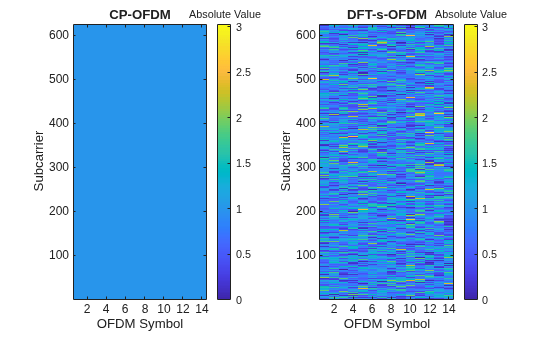
Plot the absolute values of the mapped symbols for the first layer of each grid. The CP-OFDM grid has uniform magnitude because each subcarrier carries one QPSK symbol. The DFT-s-OFDM grid varies in magnitude because DFT spreading distributes each symbol across all allocated subcarriers.
maxVal = max(abs(gridDFTsOFDM(:,:,1)),[],"all");
subplot(1,2,1)
imagesc(abs(gridCPOFDM(:,:,1)))
axis xy
clim([0 maxVal])
colorbar
title(colorbar,"Absolute Value")
xlabel("OFDM Symbol")
ylabel("Subcarrier")
title("CP-OFDM")
subplot(1,2,2)
imagesc(abs(gridDFTsOFDM(:,:,1)))
axis xy
clim([0 maxVal])
colorbar
title(colorbar,"Absolute Value")
xlabel("OFDM Symbol")
ylabel("Subcarrier")
title("DFT-s-OFDM")
Input Arguments
Output Arguments
More About
Extended Capabilities
Version History
Introduced in R2026b

