MLSE Equalization with Dynamically Changing Channel
Use a Maximum Likelihood Sequence Estimation (MLSE) equalizer to equalize the effects of a multipath Rayleigh fading channel. The MLSE equalizer inputs data that has passed through a time varying dispersive channel and an estimate of the channel. The channel estimate contains dynamically evolving channel coefficients of a two-path Rayleigh fading channel.
Model Structure
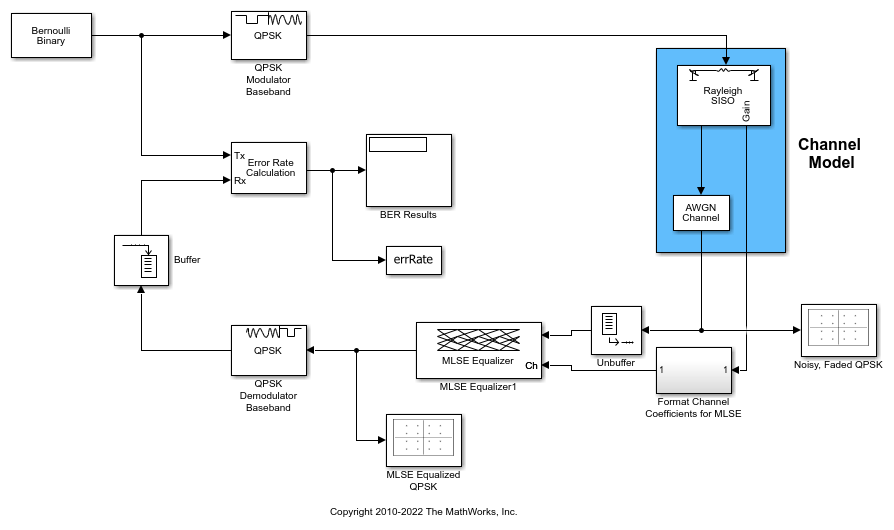
The transmitter generates QPSK random signal data.
Channel impairments include multipath fading and AWGN.
The receiver applies MLSE equalization and QPSK demodulation.
The model uses scopes and a BER calculation to show the system behavior.
Explore Example Model
Experimenting with the model
The Bernoulli Binary Generator block sample time of 5e-6 seconds corresponds to a bit rate of 200 kbps and a QPSK symbol rate of 100 ksym/sec.
The Multipath Rayleigh Fading Channel block settings are:
Maximum Doppler shift is 30 Hz.
Discrete path delay is [0 1e-5], which corresponds to two consecutive sample times of the input QPSK symbol data. This delay reflects the simplest delay vector for a two-path channel.
Average path gain is [0 -10].
Average path gains are normalized to 0 dB so that the average power input to the
AWGNblock is 1 W.
The MLSE Equalizer block has the Traceback depth set to 10. Vary this depth to study its effect on Bit Error rate (BER).
The QPSK demodulator accepts an N-by-1 input frame and generates a 2N-by-1 output frame. This output frame and a traceback depth of 10 results in a delay of 20 bits. The model performs frame-based processing on frames that have 100 samples per frame. Due to the frame-based processing, there is an inherent delay of 100 bits in the model. The combined receive delay of 120 is set in the Receive delay parameter of the Error Rate Calculation block, aligning the samples.
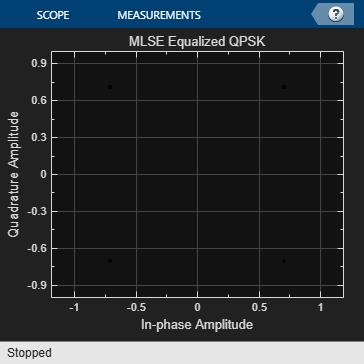
The computed BER is displayed. Constellation plots show the constellation before and after equalization.
BER = 0.033508